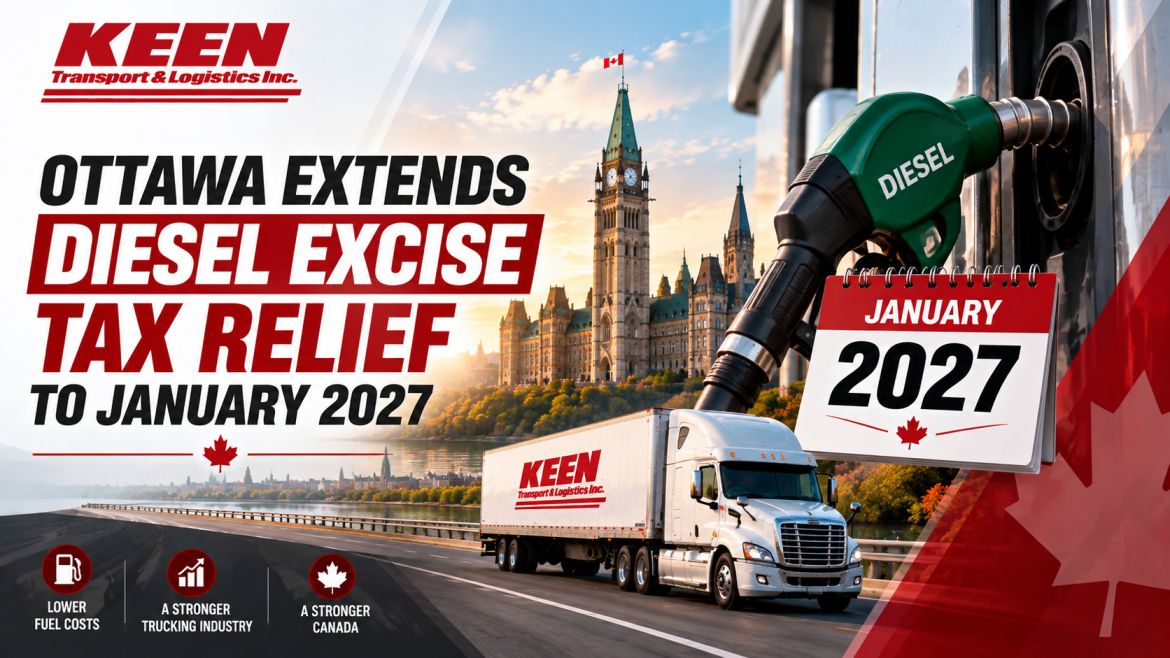
Ottawa extended its suspension of the federal excise tax on diesel and gasoline through January 31, 2027. Finance Minister François-Philippe Champagne announced the extension on September 3, 2026, pushing back what was supposed to be a September 7 expiry date.
The relief started April 20, 2026, and was due to lapse this fall. Instead, the federal government is now phasing it out gradually: a partial 2-cents-per-litre diesel rate returns February 1 to March 31, 2027, before the full 4-cents-per-litre rate resumes April 1, 2027. Gasoline’s normal rate is 10 cents per litre.
The Canadian Trucking Alliance welcomed the move, pointing out that fuel is the second-largest expense for most fleets after labour. Ottawa pegs the extension at roughly $2.9 billion in additional relief, bringing total 2026-27 relief to about $5.3 billion.
What This Means for Manitoba Shippers
If you’re budgeting freight spend for Q4 and into early 2027, this changes the math. Fuel surcharges that might otherwise have climbed heading into winter should stay flatter through January, then step up gradually rather than jumping all at once.
For any logistics company managing multi-lane freight budgets across the Prairies, that’s a real planning advantage. It buys a few months of cost stability before carriers start rebuilding fuel surcharge tables ahead of the April reset.
It’s not a reason to ignore fuel entirely, though. Rates negotiated now should still reference a fuel surcharge index tied to diesel pricing, not a flat number, so contracts adjust automatically when the phase-out begins.
What Changed and Why
The original suspension was framed as short-term relief tied to trade tensions and global economic uncertainty, including tariff pressure on Canadian exporters. Rather than let it expire on schedule, Ottawa opted to extend it through the winter months when consumer and business fuel costs typically bite hardest.
For a trucking company running a mixed diesel fleet across Manitoba and into the U.S., the extension removes one variable from an already complicated cost picture that includes tariffs, insurance, and driver wages. Any logistics company juggling multiple carriers across the same lanes should feel the difference in Q4 budgeting meetings too.
- Original relief window: April 20, 2026 to September 7, 2026
- Extended through: January 31, 2027
- Estimated additional relief: $2.9 billion
- Total 2026-27 relief estimate: $5.3 billion
How the Phase-Out Will Actually Work
The return to full taxation isn’t a cliff. From February 1 to March 31, 2027, diesel is taxed at 2 cents per litre — half the normal rate. The full 4-cents-per-litre diesel rate and 10-cents-per-litre gasoline rate resume April 1, 2027.
That staged approach matters for anyone locking in shipping contracts this fall. A rate agreed to in October that runs through May will cross two different tax regimes, so it should be built to flex rather than fixed for the full term.
What Shippers Should Do Before the Next Phase-Out
The window between now and February 2027 is the time to get contract language right, not to assume the relief is permanent. A few practical steps make the transition easier when the partial rate returns.
- Ask for a fuel surcharge tied to a published diesel index, not a fixed cents-per-kilometre number that ignores the tax change.
- Confirm in writing when your carrier will adjust surcharges — some update monthly, others quarterly, and that lag matters when a tax rate shifts mid-contract.
- If you run cross-border freight, ask how the carrier is tracking CARM and tariff exposure separately from the fuel tax, since the two get confused in budgeting conversations.
- Get a written estimate of what a full return to the 4-cent diesel rate would add to your typical monthly freight bill, so April 2027 isn’t a surprise.
None of this requires switching carriers. It just means asking the carrier you already use to show its work on how fuel costs move through to your invoice.
Fuel Costs and Why the Carrier You Choose Matters
Being named a top trucking company isn’t just about fleet size — it’s about whether the savings from something like this actually reach the shipper, or get absorbed somewhere in a broker chain first.
An asset-based carrier that owns its trucks and pays its own fuel bills can pass tax relief straight into freight rates. A broker reselling capacity from multiple subcontracted carriers has less visibility into whose fuel costs are actually changing, and less incentive to adjust quickly.
Shippers evaluating a top trucking company for a long-term lane should ask directly how fuel cost changes flow into their rate, and how often surcharges get recalculated. A logistics trucking company that also handles warehousing sees the fuel numbers on both the linehaul and the yard equipment, not just the highway miles, which usually makes those answers more precise.
A Manitoba Driver Just Won a National Award
The same week the tax extension landed, Manitoba trucking had its own headline. Larry Procure of Altona, Manitoba, driving for Winnipeg-based Arnold Bros. Transport, was named the 2026 CTA/Volvo Trucks Canada National Driver of the Year, announced September 8, 2026 during National Trucking Week.
Procure has logged nearly 3 million miles over his career, mentors new drivers through Arnold Bros.’ training program, and sits on the company’s driver advisory board. It’s the second year running that a Manitoba driver has taken the national title.
It’s a useful reminder alongside a fuel tax story: freight costs matter, but so does who’s actually behind the wheel. Safety records, retention, and driver mentorship affect insurance costs and on-time performance just as much as diesel prices do. For a trucking company like Arnold Bros., that kind of recognition feeds directly into safety ratings for years to come.
How Keen Transport Keeps Freight Costs Predictable
Keen Transport & Logistics operates as a logistics trucking company based in Winnipeg, running more than 100 trucks and 220+ trailers under our own name, not leased through a broker network. When federal fuel relief changes, our dispatch team adjusts surcharges directly instead of waiting on a subcontractor to report a change.
We’ve delivered more than 49,450 loads at a 97.8% on-time rate, across full truckload freight and flatbed work alike, for more than 317 customers. Our Winnipeg cross-docking and warehousing operations run alongside 24/7 dispatch, so a rate change or a road restriction gets communicated the same day it happens, not the next one.
As a trucking company, we also compete for drivers like Larry Procure. Keen is Hazmat certified, SmartWay certified, and bonded for both U.S. and Canadian freight, which matters to shippers who care about fuel efficiency and cross-border compliance in the same carrier. If you’re weighing a broker quote against a carrier that owns its equipment, request a lane-specific quote and compare what actually lands on the invoice.
Frequently Asked Questions
How do I find a reliable trucking company near me in Manitoba?
Start with carriers that are asset-based and can show real safety and on-time numbers, not just a sales pitch. Ask for references from shippers in your industry and confirm bonding, certifications, and cross-border experience before signing a contract.
Why should I search for a trucking company near me instead of going straight to a national broker?
A local carrier answers the phone at 2 a.m. when a load is delayed at the border, and knows Manitoba road restrictions and seasonal weight limits firsthand. Brokers add a markup layer and often can’t tell you which subcontractor is actually hauling your freight that day.
What’s the difference between a broker and a logistics trucking company like Keen?
A broker doesn’t own trucks; it resells capacity from other carriers and takes a margin. A logistics trucking company that also runs its own warehousing, like Keen, controls the equipment, the drivers, and the handling from pickup to delivery.
Will the diesel tax relief actually lower my freight rates?
It should help keep rates flatter through the winter than they’d otherwise be, since carriers won’t be absorbing a fuel tax increase on top of normal seasonal demand. It’s not a guaranteed discount — ask your logistics company how the relief is reflected in your fuel surcharge.
What should I check before hiring a trucking company near me for cross-border freight?
Confirm the carrier is bonded for both U.S. and Canadian customs, understands CARM and current tariff exposure, and has a dispatch team available outside business hours. Cross-border delays are usually a documentation problem, not a driving problem.
What makes a top trucking company different from a cheap one?
Price alone doesn’t show you fleet age, driver retention, or how a carrier handles a breakdown or a border hold. Look at on-time percentage, safety certifications, and whether the company owns the equipment moving your freight.
When does the fuel tax relief end, and should I lock in rates now?
The partial rate returns February 1, 2027, with full taxation back April 1, 2027. If you’re negotiating a contract that spans that window, build in a surcharge that adjusts with the published rate rather than locking a flat number for the full term.
Ship With a Carrier That Owns Its Fleet
Keen Transport & Logistics runs 100+ trucks and 220+ trailers out of Winnipeg, with a 97.8% on-time record across more than 49,450 loads. No broker markup, no handing your freight to a stranger — our equipment, our drivers, our dispatch.
Call 24/7 dispatch at (204) 943-5336, email info@keentransport.ca, or request a free quote and we’ll price your lane the same day. Interested in driving for a carrier that mentors drivers the way Arnold Bros. does? Our careers page is open.