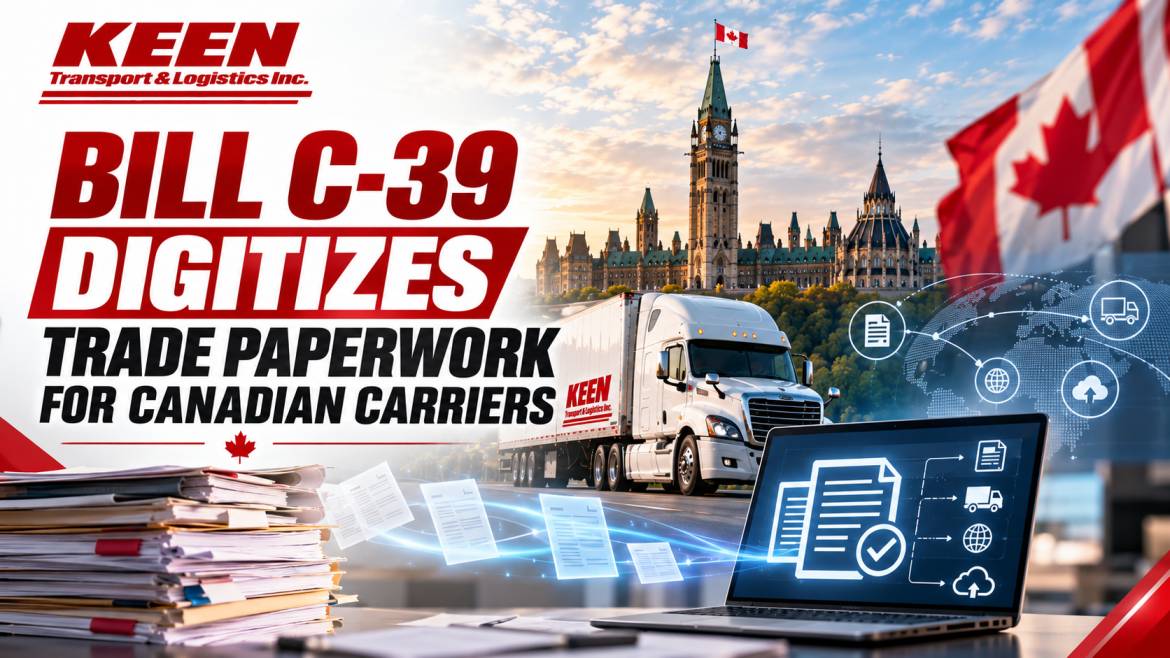
On September 21, 2026, the federal government tabled Bill C-39, the Building Canada Strong Act, and a good part of it is aimed squarely at freight. According to the Government of Canada announcement, the bill would designate strategic trade corridors, push trade paperwork online and step up enforcement against worker misclassification.
The Canadian Trucking Alliance responded the next day, September 22, saying it “strongly welcomes” the bill. In its statement, CTA president and CEO Stephen Laskowski said the measures show “a clear commitment to fortifying national trade corridors, eliminating unnecessary administrative friction at our borders, and ensuring our essential commercial drivers operate in a fair, safe, and modern environment.”
Nothing in the bill is law yet. It still has to move through Parliament, and the paperwork details will come later. Any trucking company that crosses the border should be reading it now, and so should shippers.
What This Means for Manitoba Shippers
Most of what the bill promises is slow, background change. You will not see a different invoice next month. What you may see, over the next couple of years, is less duplicate data entry and fewer paper documents chasing a truck across the border.
For a shipper, three things matter most. First, electronic trade documents would carry legal weight equal to paper ones. Second, the government wants businesses to give customs and transportation agencies the same information once, not three times. Third, misclassification enforcement is aimed at the carriers that undercut everyone else on price by cutting corners with their drivers.
That last point affects your risk, not just your rates. A freight provider that treats drivers as unincorporated contractors to save on payroll costs is a carrier that may not hold up under closer inspection. When you pick a logistics trucking company, ask how its drivers are employed. It is a fair question, and it is about to matter more.
The practical advice is simple. Ask your logistics company how it handles electronic documents today, and keep your own commercial data clean.
What Bill C-39 Changes for Trade Paperwork
The paperwork section is the part most shippers will care about. Based on the bill summary on OpenParliament, the legislation enacts an Enabling Digital Trade Act. That Act sets out rules for electronic trade documents to be treated as the functional equivalent of paper trade documents.
“Tell Us Once, Tell Us Digitally”
The government’s backgrounder describes a principle it calls “Tell Us Once, Tell us Digitally.” Businesses would submit trade information one time, and federal agencies would share and reuse it securely. The backgrounder also says the Canada Transportation Act would be amended to reduce duplicate information requests from different departments.
Anyone who has keyed the same shipment details into more than one system knows why this matters. Every re-entry is a chance for a typo, and a typo on a customs entry can hold a load for hours. Fewer entries means fewer of those.
Electronic Transferable Records
The backgrounder also talks about clarifying the validity of electronic transferable records for international trade. In plain terms, a document that used to need an original signature on paper could be recognized in electronic form. For freight tied to bills of lading and export paperwork, that removes a real delay, and a logistics company that handles export paperwork daily will notice it first.
We do not yet know which documents will be covered first, or how quickly the federal agencies will be ready. Treat any specific date you hear in the next few weeks with caution until the rules are published.
Trade Corridors and the One-Year Clock
The bill would also create National Trade Corridors, along with a National Trade Corridors Council to identify bottlenecks. The government says it will set performance metrics for corridor operations, aimed at chokepoints such as ports and railyards.
Separately, the bill sets a one-year federal decision timeline for major projects. The government’s announcement describes a Cabinet Directive that requires federal reviews and project decisions in no more than a year after a proponent submits a comprehensive application.
Manitoba sits in the middle of the country, so corridor performance is not abstract for us. Freight moving through Winnipeg to the Pacific, the Great Lakes or the US border depends on the rail yards, terminals and highways between those points. CTA has said it backs fast-tracking approvals to clear highway bottlenecks, modernize border crossings and improve intermodal connections. Shippers weighing a top trucking company for a long-haul lane should ask about intermodal options too.
Whether that shortens transit times depends on what actually gets built. A one-year review clock is not a construction schedule.
The Misclassification Piece Carriers Should Not Skip
The government’s backgrounder says it will strengthen compliance and enforcement against worker misclassification and wage theft, with particular focus on the trucking industry. It points to additional inspections, prevention activity and digital tools for enforcement. It gives little detail on how many inspectors or which Canada Labour Code changes are coming.
CTA says it supports expanded enforcement, describing the goal as “a level playing field for compliant trucking companies while protecting the rights and safety of commercial drivers.” For an owner-operator-heavy market like ours, that language should get attention.
An honest trucking company that pays its drivers as employees has always competed against operators that do not. If enforcement tightens, the price gap between the two should narrow. For shippers, a top trucking company is one whose payroll, insurance and equipment records are easy to explain.
The US Side: CBP’s Electronic Export Manifest Test
Canada is not the only country moving paperwork online. On September 23, CTA relayed a notice that U.S. Customs and Border Protection is seeking carriers for a voluntary test of an Electronic Export Manifest for truck cargo through its Automated Commercial Environment (ACE).
Under the test, limited manifest data would be due at least 24 hours before departure, and the complete manifest no later than two hours before arrival at the final export port. The test is expected to run about two years, starting 30 days after Federal Register publication. There are no restrictions based on company size, location or commodity type, but participants must be able to submit data to CBP electronically through ACE.
It applies to truck cargo leaving the United States, not loads entering Canada. Even so, it shows where both governments are heading.
How Keen Runs Freight While the Rules Change
Keen Transport & Logistics is an asset-based carrier. We own our trucks, employ our drivers and run our own dispatch, so there is no chain of subcontractors between your freight and the person driving it. That structure is exactly what misclassification enforcement is designed to reward.
We are also set up for cross-border work. Keen is C-TPAT certified, US and Canada bonded, and EDI-capable, which means structured electronic data is already part of how we move freight. As a logistics company with a bonded footprint on both sides of the border, we expect digital documentation to be an extension of what we do now, not a reinvention.
Our record supports that. Across more than 49,450 loads delivered, we have maintained 97.8% on-time delivery.
For shippers moving freight through Winnipeg, our Winnipeg warehouse and cross-docking service gives loads a place to be sorted, consolidated or held if paperwork needs to catch up. Our full truckload service and intermodal option cover the long-haul lanes where corridor improvements would matter most. If your supply chain has grown complicated, our supply chain management team can help map where the paperwork delays actually happen.
One more thing we say to every new customer: ask to see how your carrier’s drivers are hired. Any logistics trucking company worth using will answer that plainly.
Frequently Asked Questions
Is Bill C-39 in force, and do I need to change anything today?
No. As of this post, Bill C-39 has been tabled but is not law, and the rules for electronic trade documents have not been published in detail. There is nothing you are required to change today. It is a good time to review how your shipping documents are produced and stored.
How do I find a reliable trucking company near me in Manitoba?
Start with the basics: does the carrier own its trucks, employ its drivers and hold the certifications your freight requires? Ask for on-time delivery figures and how they are measured. Then call dispatch with a real question and see how quickly you get a real answer.
Will electronic trade documents speed up border crossings?
They should reduce delays caused by missing or mismatched paperwork, which is a common reason loads get held. They will not change inspections, duties or the physical crossing itself. A logistics trucking company that already files clean electronic data should benefit first.
What should I ask a trucking company near me about driver misclassification?
Ask whether its drivers are employees or contractors, and who owns the trucks they drive. Any trucking company running its own equipment with its own staff will have a short, clear answer. Vague answers are worth noting, especially with enforcement expected to increase.
Does the CBP export manifest test affect my Canadian imports?
No. It covers truck cargo leaving the United States through ACE, and participation is voluntary. If you export from Canada to the US, it is worth asking your carrier how it plans to handle electronic submissions, since the timing rules (24 hours for limited data, two hours before arrival for the full manifest) are tight.
What does a top trucking company do differently on paperwork?
It gets the documents right before the truck leaves, not after it arrives at the border. It also keeps records that another party can check, including driver employment and equipment ownership.
Can a trucking company near me quote a cross-border lane the same day?
We can. Send the origin, destination, commodity, weight and any special handling needs, and we will price it the same day. You can use the quote form or call dispatch directly.
Ship With a Carrier That Owns Its Fleet
Keen Transport & Logistics runs 100+ trucks and 220+ trailers out of Winnipeg, with a 97.8% on-time record across more than 49,450 loads. No broker markup, no handing your freight to a stranger — our equipment, our drivers, our dispatch.
Call 24/7 dispatch at (204) 943-5336, email info@keentransport.ca, or request a free quote and we’ll price your lane the same day. You can also contact our team with questions about cross-border paperwork.