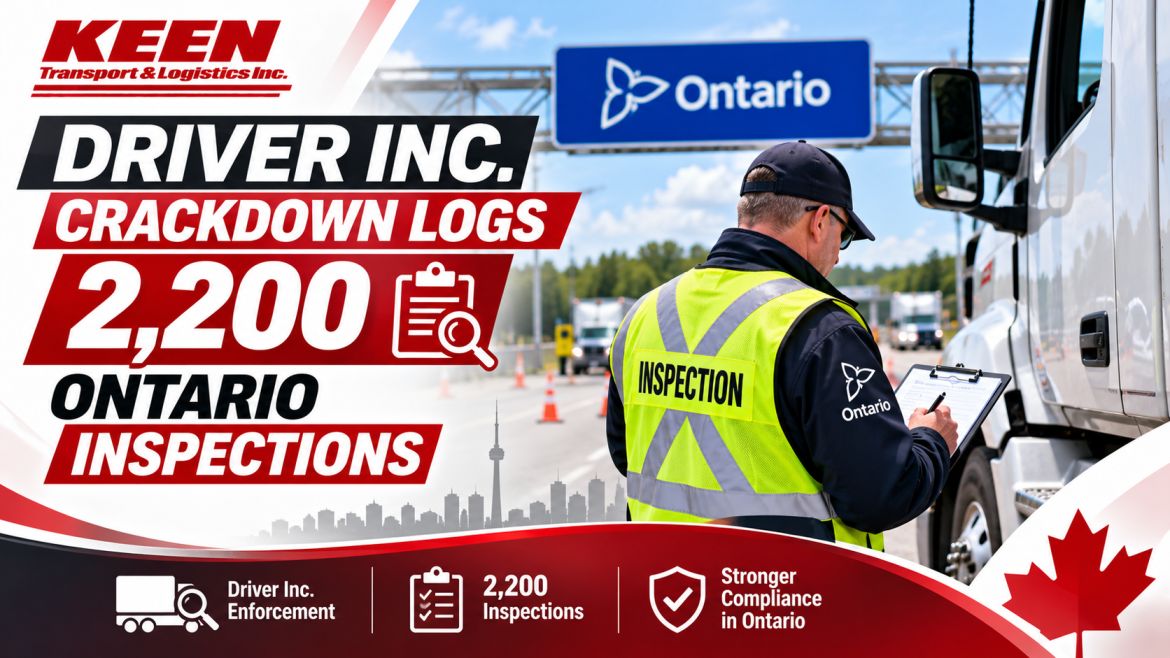
Ontario’s joint crackdown on Driver Inc. has now produced more than 2,200 inspections and compliance interactions with commercial carriers and drivers, according to a Nov. 2, 2026 report from Truck News. The Ontario Trucking Association (OTA) supplied the figures, and the work has reached 14 inspection stations across the province.
Four agencies are involved. The Ministry of Transportation (MTO) carried out 676 roadside inspections. Employment and Social Development Canada (ESDC), the Workplace Safety and Insurance Board (WSIB) and the Canada Revenue Agency (CRA) logged another 1,599 compliance interactions between them: 473 for ESDC, 659 for WSIB and 467 for CRA. The article says more enforcement is expected before the end of 2026.
Driver Inc. is the practice of classifying drivers as independent contractors when they work like employees, which can shift employment, tax and workplace insurance obligations off the carrier’s books. The enforcement is in Ontario, but the freight it touches moves through Manitoba every day.
What This Means for Manitoba Shippers
Start with what the report does not say. It describes an Ontario initiative, run at Ontario inspection stations. It does not announce a Manitoba program, and we have not seen one. Nobody should tell you Manitoba carriers are about to face the same roadside blitz.
What it does tell you is where enforcement is heading. Revenue agencies, employment-standards officers and insurers are now standing at the same inspection stations as the provincial transportation officers. A carrier that cuts corners on how it classifies drivers has a harder time hiding when four agencies compare notes. That is good news for any trucking company that already does it by the book.
For a shipper, the practical consequence is simple: the carrier you book today may not be the carrier you can book next year. Operators whose rates depend on misclassified labour can lose that advantage quickly once enforcement catches up. If your freight depends on them, so does your schedule.
Ask your current freight providers how their drivers are engaged and who owns the trucks. A solid carrier will answer in a sentence. Your own logistics company or procurement lead can add this to the next carrier review.
What Driver Inc. Is, and What the Numbers Show
The Truck News report describes Driver Inc. as a model that “can involve classifying employees as independent contractors to avoid employment, tax and workplace insurance obligations.” Those obligations are real costs, from payroll deductions to workers’ compensation premiums.
The OTA’s position, as reported, is that these practices put compliant carriers at a competitive disadvantage and deprive drivers of employment protections and benefits. Jonathan Blackham, the OTA’s director of policy and public affairs, said Driver Inc. “is not only a transportation issue, it involves employment standards, workplace protections and tax compliance.”
That is why the participating agencies matter more than the headline count. The 2,200-plus figure measures contact, not violations. The article gives no penalty or charge totals, so we will not guess. What it does show is breadth: the three partner agencies logged more interactions than the MTO’s own inspections.
Why Misclassification Shows Up in Your Freight Rate
Every carrier carries a cost for each driver on the road. An asset-based carrier pays wages, payroll taxes, insurance and benefits, then spreads those costs across the loads that driver hauls. A carrier that engages its drivers as contractors and does not carry those costs can quote lower on paper.
That gap is the competitive disadvantage the OTA keeps pointing to. It is also a risk that lands on the shipper in a quieter way, especially for a trucking company that plays by the rules and cannot match the price. When a low-cost operator is forced to reclassify drivers, restructure or leave the market, the freight it was hauling needs a new home, often at short notice.
Not every owner-operator is a problem. Legitimate ones run their own businesses. The issue is the arrangement that looks like that on paper but works like employment in practice. Telling the two apart is the regulators’ job, and it should be the shipper’s question too.
How to Vet a Carrier’s Driver Model
You do not need a lawyer to run a basic check. These are the questions a dispatcher would ask before handing freight to a new partner:
- Who employs the drivers? Ask whether the people hauling your freight are on the carrier’s payroll, and whether they drive company-owned equipment.
- Who owns the trucks and trailers? A fleet the carrier owns outright is easier to verify than a roster of units leased through third parties.
- What insurance and coverage is in place? Ask for current certificates and confirm the named insured matches the company on your rate confirmation.
- Is the carrier bonded and certified for the lanes you run? Cross-border freight needs the right paperwork behind it.
- Can they commit to capacity? A carrier with its own people and equipment can tell you what it can haul next month.
A top trucking company in this environment is one that can answer all five without hedging. If the answers come back vague, treat that as information. A logistics trucking company that owns its fleet has little reason to be vague. This is not legal advice, so let your compliance team decide what your procurement policy requires.
How the Federal Pieces Fit Together
Ontario’s blitz is the visible part of a longer effort. On Oct. 30, 2025, Truck News reported that Ottawa was promising a crackdown on driver misclassification. That included ending the moratorium on T4A penalties and having agencies collaborate so drivers claiming to be independent contractors pay their taxes. The article also noted a planned change to allow information sharing between ESDC and the CRA.
Federal Jobs Minister Patty Hajdu told the House of Commons transport committee that “misclassification is exploitation – it strips workers of their rights and creates an uneven playing field for the many honest companies that follow the rules.”
In February 2026, federal, provincial and territorial transportation ministers committed to coordinated action against Driver Inc. at their annual council meeting in Vancouver. Geoff Wood of the Canadian Trucking Alliance (CTA) welcomed the acknowledgement but cautioned that “the proof will be in the actual efforts put forth across the country.”
Put the three together and the Ontario numbers look less like a one-off. Political commitment came first, then tax and information-sharing changes, and now roadside contact at scale. Whether similar work reaches the Prairies is a question we cannot answer.
What Shippers Can Do This Month
You do not have to overhaul your carrier program. List the carriers moving your freight and note how much depends on one or two low-priced providers. Ask your key providers the vetting questions above. Then line up a backup for your highest-volume lanes, including Winnipeg to Ontario and Winnipeg to the U.S. border.
Recurring weekly runs and time-sensitive cross-dock work benefit most from a carrier that controls its own drivers and equipment.
How Keen Operates
Keen Transport & Logistics is an asset-based carrier, not a broker. We own our equipment, employ our drivers and run our own dispatch. We are not a broker, and the person who answers your call is not reselling your load to somebody else.
That shows up in the numbers we can actually back up: 100+ trucks, 220+ trailers, more than 49,450 loads delivered and a 97.8% on-time record. Our 180+ employees include the drivers on the road, not just the people in the office. As a logistics trucking company with its own fleet, we can show you who is behind each load. A logistics trucking company should be judged on its fleet, not its pitch. For customers who need full truckload capacity out of Winnipeg, the question of who is driving and who owns the unit has a short answer.
We are also US and Canada bonded, C-TPAT certified and BBB accredited, which matters when your freight crosses the border. Any trucking company can claim reliability. We would rather you check the paperwork than take our word for it.
As a Winnipeg logistics company we also run a warehouse with cross-docking and supply chain management support under one roof. And if you are a driver reading this and wondering what a direct employer looks like, see our careers page.
Frequently Asked Questions
How do I find a reliable trucking company near me in Manitoba?
Start with the basics: who owns the trucks, who employs the drivers and what certifications the carrier holds. Ask for insurance certificates and references. A carrier with its own fleet and a track record you can verify is a safer bet than one you cannot trace. That is what separates a top trucking company from a name on a load board.
Does the Ontario Driver Inc. initiative apply in Manitoba?
No. The reported initiative covers Ontario inspection stations and involves Ontario’s MTO alongside federal and provincial agencies. We have not seen an equivalent announced for Manitoba, and a top trucking company in Winnipeg should be able to explain its own driver model either way. Federal measures on misclassification, such as the T4A changes, are national in scope. A good logistics company will already be asking carriers about both.
What should I look for when choosing a trucking company near me for full truckload freight?
Look at fleet size, on-time performance, coverage and cross-border bonding. Ask how many of the drivers hauling your loads are direct employees. Then check that the answers match across their website, their paperwork and your rate confirmation.
Are owner-operators a problem for shippers?
Not by default. Legitimate owner-operators run their own businesses, with their own equipment, insurance and authority. The concern is misclassification, where someone is called a contractor but works under the carrier’s direction like an employee.
How do I know if a trucking company near me is asset-based?
Ask directly whether the carrier owns the tractors and trailers and employs the drivers. An asset-based carrier will say yes and can usually tell you fleet counts and where the equipment is based. A broker will tell you about its network of carriers instead.
Ship With a Carrier That Owns Its Fleet
Keen Transport & Logistics runs 100+ trucks and 220+ trailers out of Winnipeg, with a 97.8% on-time record across more than 49,450 loads. No broker markup, no handing your freight to a stranger — our equipment, our drivers, our dispatch.
Call 24/7 dispatch at (204) 943-5336, email info@keentransport.ca, or request a free quote and we’ll price your lane the same day. Questions first? Reach us through our contact page.