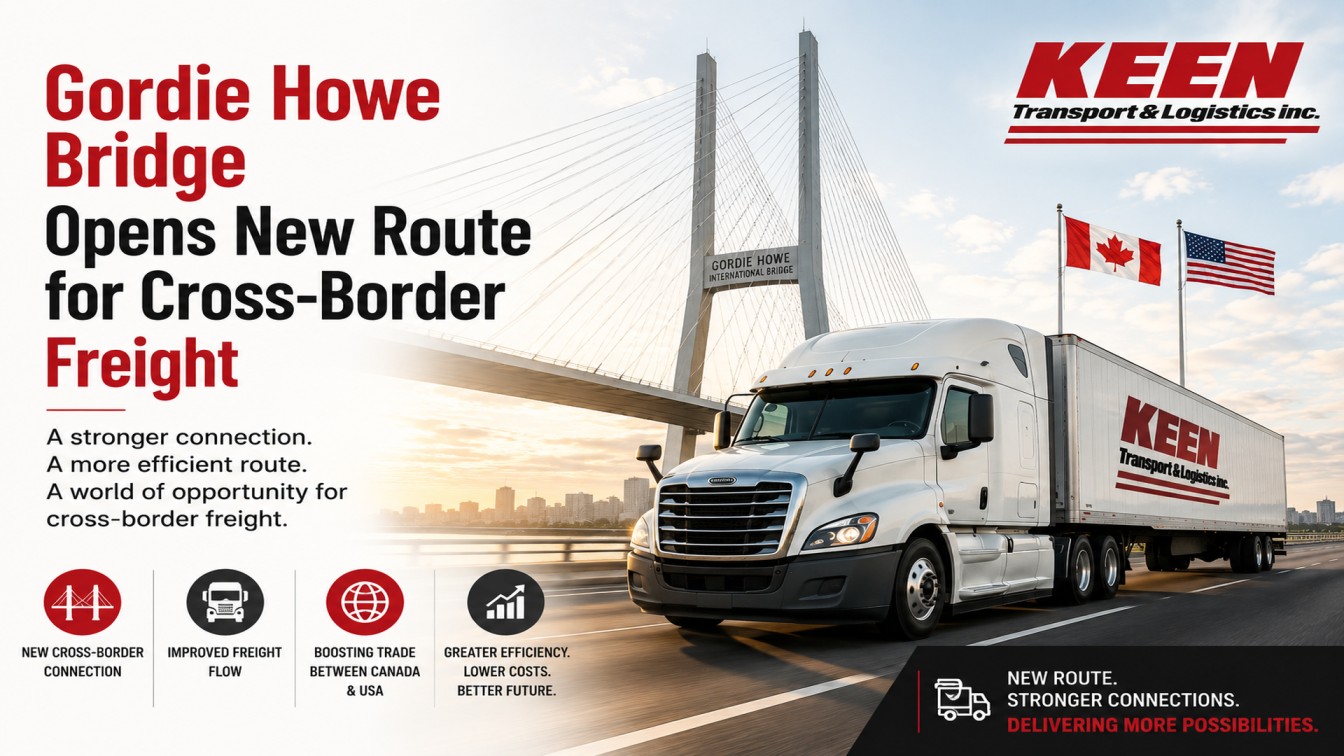
The Gordie Howe International Bridge opened to traffic on Monday, July 27, 2026, giving Windsor and Detroit a second road link across the Detroit River for the first time since the Ambassador Bridge went up in 1929. The Canadian Trucking Alliance and the Canadian Press both confirmed the opening, with commercial traffic crossing within hours of the ribbon-cutting.
The six-lane, cable-stayed bridge connects Ontario’s Highway 401 directly to Interstate 75 in Michigan, bypassing the Ambassador Bridge’s off-ramps and up to 14 traffic lights on the Canadian side. CTA president Stephen Laskowski told the Canadian Press that better traffic flow, smoother security procedures, and competitive toll rates could save large fleets as much as $100,000 a month. Mike Millian of the Private Motor Truck Council of Canada was more cautious, noting that high diesel prices mean those savings may not reach shippers right away.
For a Manitoba-based logistics trucking company that runs freight into the U.S. Midwest, this is the most significant change to the Windsor-Detroit corridor in nearly a century. Here’s what happened, what it means for shippers in Manitoba, and how it fits into the bigger picture of cross-border freight.
What This Means for Manitoba Shippers
Windsor-Detroit is the busiest commercial border crossing in North America by trade value, and a meaningful share of Manitoba exports headed for Michigan, Ohio, and points east eventually funnel through it. A second bridge means less exposure to a single point of failure. If the Ambassador Bridge closes for weather, an accident, or maintenance, freight now has an alternate route instead of sitting in a queue. Shippers who consolidate freight through our Winnipeg cross-docking facility before it moves south get the same benefit on the front end: fewer single points of failure in the lane overall.
It also means dispatchers planning Manitoba-to-Midwest lanes have a genuine routing choice for the first time in decades. That matters most for time-sensitive freight, like automotive parts or perishables moving on tight delivery windows, where an hour saved at the border is an hour saved at the dock.
A New Route, Not Yet a New Norm
The bridge itself is a 2.5-kilometre span with an 853-metre main section, the longest of its kind in North America, built at a cost of roughly $6.4 billion, funded entirely by Canada. It includes upgraded X-ray screening and modernized ports of entry on both sides, which the bridge authority describes as among the most advanced land border facilities in North America.
Toll rates favour commercial traffic that values predictability. Personal vehicles pay $8; large commercial, hazardous, or oversized vehicles pay $12 per axle. For a five-axle tractor-trailer, that puts the toll in a similar range to the Ambassador Bridge, but without the signal-light gauntlet on the Windsor side. Canada will share 50 percent of net bridge revenue with the U.S. over the next 15 years, a detail still being worked out around when that sharing begins relative to Canada recouping its construction costs.
Onfreight Logistics, a Tecumseh, Ontario carrier hauling automotive parts, was reported as the first commercial truck across. Expect early volume to be automotive-heavy given the corridor’s ties to the Detroit-Windsor auto manufacturing cluster, with general freight and less-than-truckload carriers shifting over as drivers and dispatchers get comfortable with the new approach roads.
Why the Ambassador Bridge Bottleneck Mattered
Anyone who has dispatched a load through Windsor knows the Ambassador Bridge’s Canadian approach was never built for modern volumes. Trucks funnel off Highway 401 onto city streets, through as many as 14 signalized intersections, before reaching the plaza. A single stalled vehicle or rush-hour backup could add 30 to 60 minutes to a crossing that should take ten.
The Gordie Howe Bridge removes that surface-street routing entirely by connecting highway to highway. For a logistics company running tight appointment windows into Michigan and Ohio, that’s the practical benefit: fewer variables between the yard and the border, not necessarily a cheaper toll. For a top trucking company managing those windows daily, avoiding an unpredictable approach road is worth more than a dollar or two in toll savings.
Fuel Prices Are Still the Bigger Cost Driver
Millian’s caution is worth taking seriously. Diesel prices and toll costs both factor into a lane’s total cost, and a smoother crossing doesn’t offset a spike in fuel. Any trucking company quoting Manitoba-to-Michigan freight this summer is still pricing primarily off diesel, not border efficiency. The bridge should reduce variability and detention risk at the crossing itself, which helps with on-time performance, but shippers shouldn’t expect linehaul rates to drop because a new bridge opened.
What it likely does affect is reliability. Carriers that can point to a second, modern crossing option have a stronger case for holding delivery windows on Michigan-bound freight, which matters more to a manufacturer running just-in-time inventory than a few dollars in toll savings.
How Keen Transport Approaches Cross-Border Freight
Keen Transport & Logistics Inc. is a Winnipeg logistics company and asset-based carrier running 100+ trucks and 220+ trailers, and cross-border freight has always been part of that operation. We’re U.S. and Canada bonded and C-TPAT certified, which keeps our trucks moving through fast-lane and trusted-trader programs at land crossings rather than sitting in general inspection queues.
A second, modern crossing at Windsor-Detroit is good news for any Manitoba freight carrier with regular lanes into the U.S. Midwest. It gives dispatch another routing option when the Ambassador Bridge is congested, and it adds capacity to a corridor that Manitoba manufacturers, exporters, and pulse crop shippers rely on to reach Midwest customers and connecting rail and intermodal terminals. We’ll be routing eligible loads across the new bridge as our drivers and customs brokers get familiar with the port of entry, whether that’s a dedicated full truckload move or freight consolidated through our Winnipeg terminal.
This is also where being an asset-based operation matters. We own our trucks and employ our drivers, so when a border process changes, we can adjust routing and driver instructions directly instead of relaying updates through a broker network. That’s the same reason our on-time delivery rate has held at 97.8 percent across more than 49,450 loads. Manitoba shippers evaluating a top trucking company for cross-border lanes should ask the same question we ask ourselves: how quickly can dispatch adapt when a route changes overnight?
What Shippers Should Watch Next
Any logistics trucking company running U.S. lanes should be watching the same details. The bridge opened to general traffic on July 27, but a few things are still shaking out. Toll enforcement details, FAST/NEXUS lane processing times at the new port of entry, and how quickly major carriers shift volume away from the Ambassador Bridge will all become clearer over the next few months. The Canadian Trucking Alliance has signalled it will keep tracking crossing times and toll costs as more carriers use the new route.
For now, the practical move for a Manitoba shipper is to reach out to your carrier’s dispatch team and ask whether they have a plan for using the new crossing, and whether that changes transit time estimates on U.S. Midwest lanes. A logistics trucking company that’s already testing the new route will have real data faster than one waiting to see how it plays out.
Frequently Asked Questions
Does the Gordie Howe Bridge change transit times for Manitoba-to-Michigan freight?
It should reduce variability more than it reduces baseline transit time. The highway-to-highway connection avoids the Ambassador Bridge’s surface-street approach, which is where most unpredictable delays happen. Actual time savings will depend on volume as more carriers shift over.
Will tolls on the new bridge make cross-border freight cheaper?
Not directly. Commercial toll rates are $12 per axle, in a similar range to existing crossings, and diesel remains the larger cost factor in any linehaul quote. Any savings are more likely to come from reduced delay and detention risk than from the toll itself.
How do I find a reliable trucking company near me in Manitoba that runs U.S. freight?
Look for a carrier that’s bonded in both countries, ideally C-TPAT certified, and that owns its own equipment rather than brokering loads out. Ask directly whether they have drivers and customs paperwork set up for the crossings you need.
What should I ask a trucking company near me about the new bridge before booking a lane?
Ask whether they’re routing eligible Michigan and Ohio-bound loads across the Gordie Howe Bridge yet, and how that affects their quoted transit times. A carrier that can answer specifically, rather than generally, is further along in adjusting its dispatch planning.
Is the Ambassador Bridge still an option for cross-border freight?
Yes. The Ambassador Bridge remains open and continues to carry a large share of Windsor-Detroit truck traffic. The Gordie Howe Bridge adds capacity and a routing alternative rather than replacing the existing crossing, which is exactly the kind of flexibility a top trucking company builds into its dispatch planning.
Does this affect intermodal or rail-connected freight out of Winnipeg?
Indirectly. Freight that eventually connects to rail or intermodal terminals in Michigan and Ohio benefits from a more reliable road leg to get there. It doesn’t change rail scheduling itself, but a steadier border crossing helps keep intermodal handoffs on schedule.
Why choose a trucking company near me in Winnipeg instead of a broker based elsewhere?
A local carrier knows the Manitoba side of the lane, from provincial weight rules to which yards handle cross-docking, and can put a driver on the phone within minutes if something changes at the border. An asset-based logistics company also has direct control over equipment and schedules instead of subcontracting your load out to a third party.
How does an asset-based carrier handle a change like a new border crossing?
An asset-based carrier can update driver routing, customs paperwork, and dispatch instructions directly, without waiting on a broker to relay changes from an underlying carrier. That’s one of the practical advantages of working with a transportation partner that owns its own trucks.
Ship With a Carrier That Owns Its Fleet
Keen Transport & Logistics runs 100+ trucks and 220+ trailers out of Winnipeg, with a 97.8% on-time record across more than 49,450 loads. No broker markup, no handing your freight to a stranger — our equipment, our drivers, our dispatch.
Call 24/7 dispatch at (204) 943-5336, email info@keentransport.ca, or request a free quote and we’ll price your lane the same day.