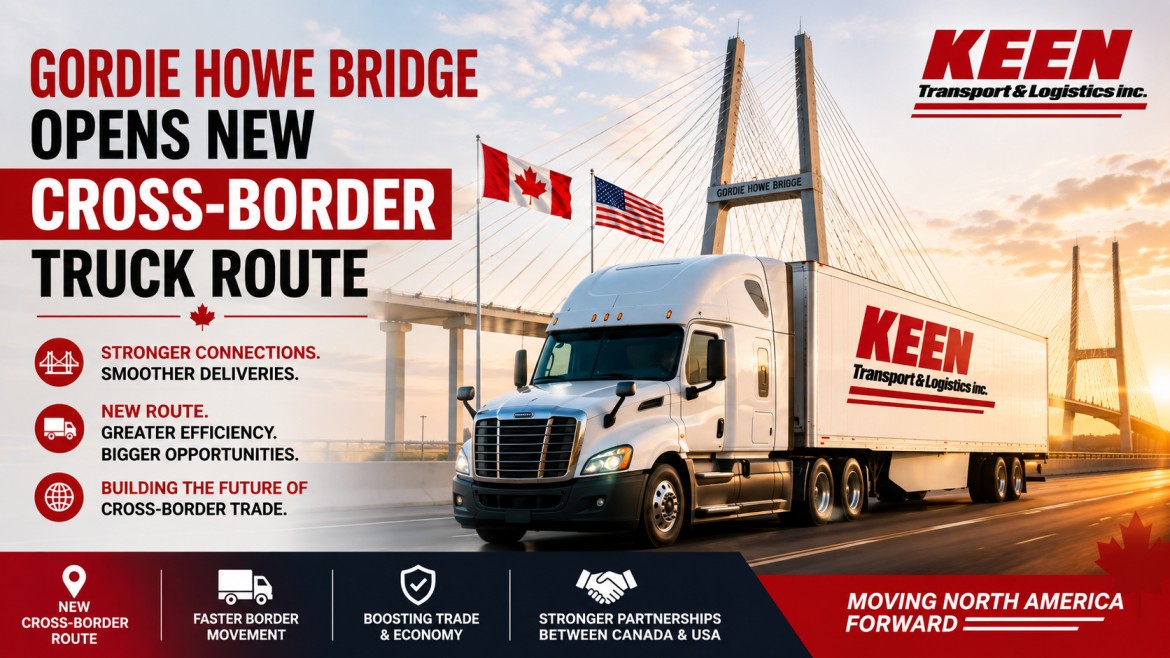
Commercial trucks started rolling across the Gordie Howe International Bridge on July 27, 2026, three days after the Windsor–Detroit crossing officially opened on July 24. The new six-lane span links Ontario’s Highway 401 directly to Interstate 75 in Michigan, removing the traffic lights and off-ramps that have slowed trucks at the aging Ambassador Bridge for decades.
Trucknews.com reported that the Canadian border plaza was built with 24 primary inspection lanes and 14 secondary examination bays — the most of any port of entry in Canada — plus a permanent, 24-hour X-ray imaging facility. Canadian Trucking Alliance president Stephen Laskowski told BNN Bloomberg that many inspections which used to require offloading a trailer can now clear through the X-ray machine instead.
Canada’s Minister of Housing and Infrastructure, Gregor Robertson, said the crossing should save carriers roughly 850,000 hours a year in wait time. Nearly three million trucks cross the Windsor–Detroit corridor annually, carrying an estimated $300 billion in trade, according to figures cited by Canada’s Ambassador to the U.S., Mark Wiseman.
What This Means for Manitoba Shippers
The bridge sits roughly 2,300 kilometres east of Winnipeg, and most Manitoba freight bound for the U.S. still crosses at Emerson into Pembina, North Dakota — not through Windsor. That’s worth saying plainly: this is not a Manitoba border story in the literal sense.
It still matters here, for three reasons. First, capacity: carriers with national footprints reallocate equipment and drivers around lanes that run more efficiently, and a faster Windsor–Detroit corridor can loosen up trailers and driving hours that ripple through the wider Canadian network, Prairie lanes included. Second, technology: CBSA’s investment in large-scale, non-intrusive X-ray screening at Gordie Howe points to where border processing is headed generally, and Prairie crossings will likely see comparable upgrades over time. Third, rate benchmarking: when large carriers report six-figure monthly savings on the Windsor corridor, that shifts the cost baseline shippers use when comparing a quote from any logistics trucking company, Manitoba included.
A logistics trucking company that also runs a Winnipeg warehouse can absorb some of that volatility for customers, because cross-docking and storage give dispatch more room to consolidate loads instead of chasing single-truck rates on the spot market.
Inside the New Border Crossing Technology
The scale of the Canadian port of entry is what stands out in the reporting. Up to 16 lanes can process commercial traffic during peak periods, and every inspection booth is equipped with FAST lane technology so CBSA can shift capacity as volume changes through the day.
CBSA director Sydney Kale described the imaging system as a way to identify loads that need a closer look “without automatically requiring a full cargo examination.” That distinction matters to any freight carrier moving time-sensitive loads: fewer trailers pulled for manual unload means fewer hours lost sitting in a compound.
The complex also includes a dedicated oversized-vehicle lane and a hazardous-goods examination canopy with its own environmental containment system, so dangerous-goods loads no longer need to be routed to an off-site facility for inspection. For a dangerous-goods-certified operation, that kind of on-site handling is the difference between a load that clears in an afternoon and one that sits overnight.
Why Diesel Prices and Tariff Uncertainty Still Matter More Than One Bridge
Faster processing does not automatically mean cheaper freight. Mike Millian, president of the Private Motor Truck Council of Canada, told BNN Bloomberg that high diesel prices, layered on top of a difficult few years for the industry, mean the bridge’s efficiency gains may not translate into lower shipping costs for customers right away.
There is a second headwind shippers should track. On July 2, 2026, the Canadian Trucking Alliance noted that the U.S. administration had declined to extend CUSMA on a multi-year basis, leaving carriers and exporters without the longer-term certainty they had been asking for. For Manitoba’s pulse crop, soya bean, and manufacturing exporters, that uncertainty is arguably a bigger day-to-day cost factor than any single border crossing.
Put together, the picture for shippers is mixed: better physical infrastructure on one major corridor, but ongoing trade-policy and fuel-cost pressure that a single bridge cannot fix. A transportation partner that owns its own equipment has more room to absorb that volatility than one that is re-brokering capacity it does not control.
What Carriers and Shippers Should Watch Next
A few things are worth watching over the next several months. Whether CBSA processing times at Windsor actually shorten in practice, once volume ramps up past the opening-week numbers being reported now. Whether any of the projected savings show up in published spot rates rather than staying inside individual carriers’ margins. And whether the federal government signals similar capital investment at Prairie crossings, where infrastructure has not seen anything close to this scale of upgrade.
None of that changes what a Manitoba shipper needs day to day: predictable transit times, a carrier that answers the phone, and equipment that shows up when it’s booked. Those fundamentals do not depend on which bridge is in the news, and they’re still how most shippers judge a top trucking company in practice.
How Keen Operates Through Border and Rate Volatility
Keen Transport & Logistics is an asset-based carrier — we own our own trucks and trailers and employ our own drivers, rather than brokering loads to a third party. That structure is what lets an operation stay predictable when the news cycle around tariffs, border technology, or fuel prices gets noisy.
We run more than 100 trucks and 220-plus trailers out of Winnipeg, with a Winnipeg warehouse for cross-docking and 24/7 dispatch. Across more than 49,450 loads delivered, we’ve held a 97.8% on-time record. We’re U.S. and Canada bonded, C-TPAT and Hazmat certified, and equipped to handle dangerous goods — credentials that matter directly when a border crossing changes how inspections happen.
Whether the freight is moving on a full truckload, needs a flatbed for oversized equipment, or has to stay temperature-controlled in a heated van, the same asset base and the same dispatch team handle it start to finish. For shippers evaluating options, that consistency is usually a better test of a top trucking company than any single piece of infrastructure news.
We also work as a logistics company in the broader sense of the word, not just a fleet for hire. Our supply chain and City Division teams handle daycab and 5-ton moves around Winnipeg and rural Manitoba, so a single logistics company relationship can cover a shipper’s long-haul and local legs without adding a second vendor to manage.
Frequently Asked Questions
Does the Gordie Howe Bridge affect freight moving out of Manitoba?
Not directly — most Manitoba-to-U.S. freight crosses at Emerson into Pembina, North Dakota, not through Windsor. The bridge matters more as a signal of where border technology and national trucking capacity are headed, which eventually affects rates and equipment availability across the country.
How do I find a reliable trucking company near me in Manitoba?
Start by checking whether the carrier owns its own trucks and trailers or is re-brokering your freight to someone else. Ask for their on-time delivery percentage, confirm their bonding and safety certifications, and check whether they have local dispatch you can actually reach, not a call centre.
What should I look for when searching for a trucking company near me versus a national carrier?
A local Winnipeg carrier typically knows Manitoba-specific issues — spring road restrictions, rural access, grain and pulse crop seasonality — better than a large national player dispatching from out of province. Ask about their cross-border bonding and hours-of-service compliance either way.
Is it worth switching from a broker to an asset-based logistics company?
It depends on your volume and how much visibility you need. An asset-based logistics company controls its own trucks, trailers, and drivers, so there’s one point of accountability if something goes wrong in transit, instead of a broker chasing down whichever carrier picked up the load. When you’re comparing a logistics trucking company against a pure broker, ask directly who owns the equipment your freight will actually move on.
Will faster border processing at Windsor lower my freight rates?
Not necessarily, and not immediately. Industry voices like the Private Motor Truck Council of Canada have been clear that diesel prices and broader cost pressures are still weighing on rates, so efficiency gains at one crossing don’t automatically flow through to lower quotes.
How does CUSMA uncertainty affect Manitoba exporters?
Without a confirmed multi-year extension, exporters of pulse crops, soya beans, and manufactured goods are pricing in more risk around tariffs and documentation requirements. That uncertainty tends to matter more to day-to-day landed costs than any single infrastructure project.
What certifications should a trucking company near me carry for dangerous goods or cross-border freight?
Look for dangerous goods certification, U.S. and Canada bonding, and either C-TPAT or a comparable trusted-trader program. Hazmat certification and EDI capability are also worth confirming if your freight needs tight documentation or scheduling. These are the same credentials worth checking before naming anyone a top trucking company on paper.
Does Keen operate as a broker or as an asset-based carrier?
Keen is asset-based — we own our trucks and trailers and employ our own drivers rather than brokering freight out to a third party. That’s part of why we can hold a 97.8% on-time record across more than 49,450 loads.
Ship With a Carrier That Owns Its Fleet
Keen Transport & Logistics runs 100+ trucks and 220+ trailers out of Winnipeg, with a 97.8% on-time record across more than 49,450 loads. No broker markup, no handing your freight to a stranger — our equipment, our drivers, our dispatch.
Call 24/7 dispatch at (204) 943-5336, email info@keentransport.ca, or request a free quote and we’ll price your lane the same day.