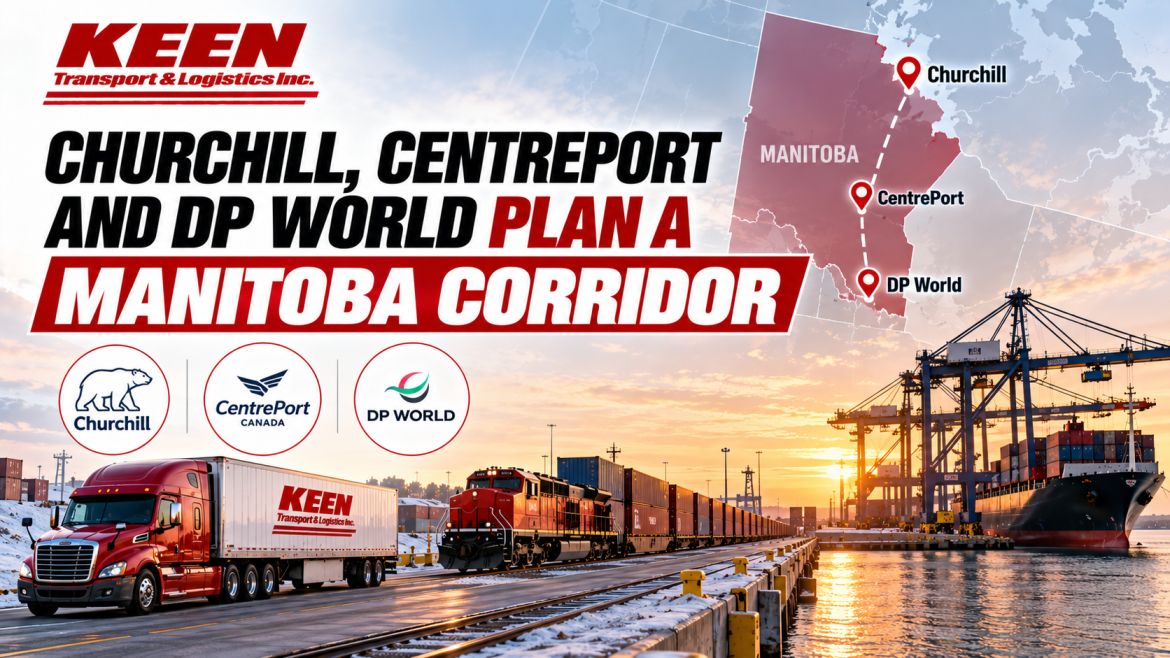
On October 26, 2026, Arctic Gateway Group, CentrePort Canada and DP World signed a memorandum of understanding to explore a new trade corridor through Manitoba. The idea is to link the Port of Churchill, the Hudson Bay Railway and CentrePort’s inland hub in Winnipeg with DP World’s global network, according to Truck News.
It is an agreement to explore, not a finished route. The report mentions no dollar figures and no timelines, and no cargo has been announced beyond “Western Canadian commodities.” Still, it puts a Winnipeg-area inland port and a global terminal operator in the same plan as Churchill, and that matters for anyone who ships grain, pulse crops or manufactured goods out of this province.
Arctic Gateway Group is the Indigenous- and community-owned operator of the Port of Churchill and the Hudson Bay Railway. CentrePort Canada is a 20,000-acre inland port and foreign trade zone with truck, rail and air connections. DP World, according to the same report, handles more than one million TEUs a year in Canada.
What This Means for Manitoba Shippers
Nothing changes on your dock this week. But the direction is worth knowing, because every new rail-and-port corridor still starts and ends with a truck, and any trucking company serving the inland hub will feel the demand first.
Freight does not teleport from a plant in Portage la Prairie to a railcar. Someone has to haul it to a yard, a transload building or a container terminal, often on a tight appointment. If CentrePort becomes a stronger gateway to the Arctic and to overseas markets, local trucking capacity at the front end becomes part of the corridor’s value.
For Manitoba exporters, the realistic takeaways are these:
- More routing options over time. CentrePort’s president and CEO, Carly Edmundson, said DP World’s network will help companies access four trade corridors that intersect at CentrePort, including the Arctic gateway via the Port of Churchill.
- More pressure on first-mile and last-mile hauling. Containers, bulk products and palletized freight all need to reach the inland hub on time.
- A longer planning horizon. No switch-over date has been given, so plan around it rather than book against it.
What the Agreement Says, and What It Does Not
A memorandum of understanding is a statement of intent. Truck News reports that the agreement focuses on port operations, logistics services, and better connecting Western Canadian commodities with international markets. It also mentions potential intermodal trade routes linking Europe and Asia through Canada.
What it does not give you is a rate, a schedule or a service start date. Before you restructure a supply chain around a corridor that has not opened, ask a simple question: what happens to my freight if the corridor takes three years to materialize? A sound plan works either way.
The partners have also been working together for most of this year. In a January 19, 2026 release, CentrePort announced the Ports Manitoba Project, a separate MOU among Arctic Gateway Group, the Winnipeg Airports Authority and CentrePort, with Prairies Economic Development Canada and the Province of Manitoba as government partners. It described Arctic Gateway as owned by 41 northern and Indigenous communities and set out a goal of linking air, land and sea transport into one supply chain.
Why the Inland Port Matters More Than the Headline
Shippers should watch the inland end as closely as the port, because that is where trucks, rail and warehousing meet.
An inland port earns its keep by taking work off the coast. Containers get cleared, sorted and consolidated closer to where the freight is produced. Edmundson put it this way in the Truck News report: “Inland ports play an important role in extending the reach of seaports.”
For a Manitoba shipper, that can mean fewer touches, fewer long-haul empties and fewer surprises at a congested coastal terminal. It can also mean more demand for drayage, transloading, cross-docking and short-haul work.
That is the part of the chain where a Winnipeg carrier with its own equipment has a real role. A broker can find a truck, but a broker cannot promise the same driver and the same trailer at 6:00 a.m. every Tuesday.
Where Trucks Fit in a Port-and-Rail Corridor
Rail moves freight cheaply over distance. Ships move it cheaper still. Neither one picks up from your loading dock.
In a corridor like the one being explored, trucks do four jobs that rarely make the press release:
- First-mile pickup. Grain, pulse crops, special crops and manufactured goods move from the producer to a rail siding, transload site or container yard.
- Container drayage. Boxes shuttle between terminals, depots and warehouses within the Winnipeg region.
- Last-mile delivery. Imported or returning freight reaches the customer, often across rural Manitoba.
Each of those is a place where timing breaks. A missed gate appointment can cost a container its sailing or a railcar its slot, so judge the trucking leg on reliability, not just price. Reliability on that leg is what a top trucking company is really selling.
A good logistics company will explain how it handles those handoffs. A logistics trucking company with its own fleet can book them around real driver availability. Ask: who books the appointment, who covers a late arrival, and what happens when a trailer sits for four hours waiting to unload.
How to Prepare Your Freight Plan Now
You do not need to wait for the corridor to open to get ready for it. A few steps cost little and pay off either way.
Map your current lanes and handoffs
Write down where your freight starts, transfers and ends, including rail yards, ports and border crossings. A single handoff often causes most of the delay.
Ask about intermodal capability before you need it
If you move bulk or container freight, find out whether your trucking company already runs intermodal work and how it handles pickups and drop-offs. Our own intermodal services are built around that kind of handoff.
Check your warehouse and cross-dock options
A new corridor will likely increase demand for transloading and short-term storage near the inland hub. Knowing where you can stage freight in Winnipeg gives you room to react. Details on our warehouse and cross-docking services are online if you want to see how that works in practice.
How Keen Operates Around a Corridor Like This
Keen Transport & Logistics is an asset-based logistics trucking company: we own our trucks, we employ our drivers, and we are not a broker. That means 100+ trucks and 220+ trailers dispatched from our Winnipeg yard, with 24/7 dispatch at (204) 943-5336.
Gate appointments leave little room for excuses. Across 49,450+ loads delivered, our on-time rate is 97.8%, which is what a shipper needs when a terminal slot is booked for 7:30 a.m.
As a logistics company with a Winnipeg warehouse, we also handle cross-docking, which suits consolidation and transloading. For freight that has to move across the border, we are US and Canada bonded, C-TPAT certified and EDI-capable. We also hold Hazmat and dangerous goods certifications.
The Manitoba sectors we serve include aerospace, retail, manufacturers and exporters, pulse crops, soya bean and special crops. Several of those are the “Western Canadian commodities” the announcement refers to.
When a shipper asks what separates a top trucking company from the pack in this kind of freight, we point to the basics: owned equipment, trained drivers and a dispatcher who answers the phone. We are also a diverse-owned and visible-minority-owned business, and we partner with women-owned and Indigenous-led enterprises across the province, which fits the community-owned character of this corridor.
If your freight starts with a full truckload to a rail yard or terminal, our full truck load services cover that first leg.
What We Are Watching Next
Three things will tell shippers whether this agreement turns into real service.
The first is a pilot, a first sailing or a first rail movement, which would turn an MOU into something you can price. The second is any government funding, since the report mentions none. The third is how CentrePort develops warehouse and transload capacity, because that is where trucking demand would show up first. As a Winnipeg logistics company, we will report it plainly if a real service window appears.
Frequently Asked Questions
Does this agreement mean Churchill is open for container service right now?
No. The October 26 agreement is a memorandum of understanding to explore opportunities. Truck News does not report a start date, a pilot service or a funding amount. Keep your current routing in place and treat Churchill as a possible future option.
How do I find a reliable trucking company near me in Manitoba for intermodal freight?
Start by asking whether the carrier owns its trucks and employs its drivers, or brokers the load to someone else. Then ask any logistics trucking company for on-time performance numbers and how they handle terminal and rail yard appointments. A carrier that can answer both questions without hesitation is worth a trial load.
Will freight rates in Winnipeg change because of a new corridor?
Nobody can say yet, and we would be guessing if we tried. Ask your freight provider how it would price lanes feeding a new hub. Rates depend on lane balance, fuel, and capacity. If the corridor brings new inbound or outbound volume, some lanes could tighten, but that depends on actual service starting.
Can a trucking company near me handle both rail-yard pickups and cross-border loads?
Yes, if it has the right authority and equipment. Ask the trucking company about bonding, C-TPAT status and EDI capability up front. These determine whether the same carrier can handle a rail-yard pickup on Monday and a US delivery on Tuesday.
Is there a trucking company near me that can quote an intermodal lane today?
Most carriers can give a ballpark by phone, but a firm quote needs the pickup point, delivery point, weight, commodity and timing. Call our dispatch line or use the quote form, and we will price your lane the same day.
What should I ask a top trucking company before booking a time-sensitive move?
Ask who picks up the phone at 5:00 a.m., what the process is if a driver runs late, and how the carrier tracks trailers. Also ask what happens when a terminal rejects a load. The answers show you how the carrier behaves when something goes wrong.
Ship With a Carrier That Owns Its Fleet
Keen Transport & Logistics runs 100+ trucks and 220+ trailers out of Winnipeg, with a 97.8% on-time record across more than 49,450 loads. No broker markup, no handing your freight to a stranger — our equipment, our drivers, our dispatch.
Call 24/7 dispatch at (204) 943-5336, email info@keentransport.ca, or request a free quote and we’ll price your lane the same day.