
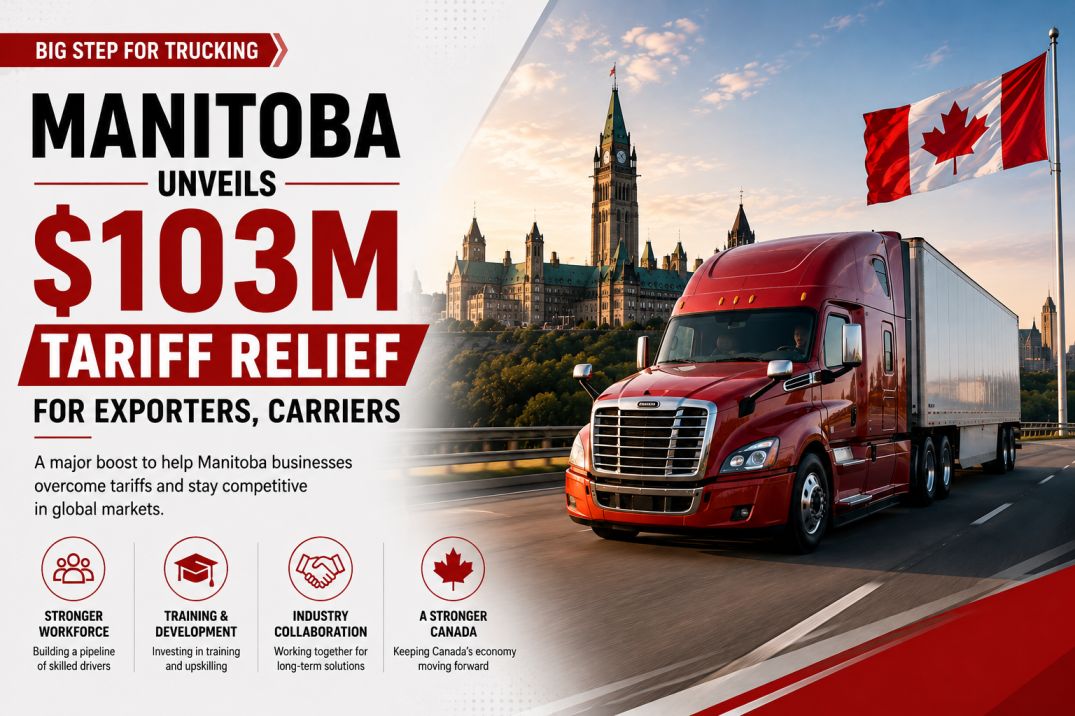
Manitoba is putting more than $103 million behind businesses caught in the latest round of U.S. tariffs. The province announced the package on August 28, 2026, and it covers everything from low-interest working capital loans to expanded export advisory services.
Business Minister Jamie Moses called it “a comprehensive suite of programs to ensure that our economy in Manitoba will weather the storm.” Agriculture Minister Ron Kostyshyn was blunter about the pressure behind it: “There’s no doubt. There are challenges moving forward with the 50 per cent tariff.”
For a logistics trucking company moving freight in and out of Manitoba every day, this isn’t background noise. It’s a direct signal about which lanes are under strain, which shippers need financing help to keep production running, and where freight volumes could shift over the next two quarters.
Any logistics company with exporter clients in this province should be reading the fine print, not just the headline number.
What This Means for Manitoba Shippers
If you run production, procurement, or logistics for a Manitoba manufacturer or exporter, the tariff support package changes your near-term math in three ways.
First, working capital gets easier to access. The new $50 million Manitoba Trade Resilience Loan Program is built for exactly this moment — businesses that need cash on hand while a customer’s order slows down or a supplier’s cost jumps. Second, export diversification gets cheaper, with the province doubling its Export Support Program and adding $250,000 for export advisory services aimed at finding buyers outside the U.S. Third, agricultural shippers moving grain, oilseed, or specialty crops get better loan guarantee terms through MASC, with the guarantee ceiling raised from 25 to 33.33 percent.
None of that moves a single pallet. But it does tell a transportation partner where demand is likely to hold steady, where it might soften, and where new export lanes could open up as Manitoba businesses look past the U.S. border.
Where the $103 Million Is Going
The package breaks down across a handful of programs, and the mix matters for anyone trying to read where freight activity is headed. Global News reported the full $103 million figure alongside comments from both ministers.
- $50 million — Manitoba Trade Resilience Loan Program, low-interest working capital for tariff-exposed businesses
- $13.7 million — Tariff Workforce Stabilization and Youth Employment Program, aimed at keeping trained staff on payroll through 2026 and 2027
- $3 million — increase to the MASC Operating Credit Guarantee Program, with the diversification loan guarantee now open to grain and oilseed operations up to $5 million
- $500,000 — Made-in-Manitoba initiative funding, plus a matching $500,000 for interprovincial trade missions
- Retail sales and payroll tax payment deferrals running September through December 2026
The province named manufacturing, agri-food, transportation, construction, wholesale trade, aerospace, forestry, steel, machinery, and beverages as the sectors this is meant to support. Aerospace and agri-food exporters — pulse crops and soya bean in particular — are two of the groups a Winnipeg carrier serving Manitoba’s export base sees the most freight from, so it’s worth watching how quickly these programs get taken up. A dependable logistics trucking company tracks these program rollouts the same way it tracks fuel prices or border wait times — as a direct input into planning capacity.
Why Winnipeg Carriers Are Watching the Tariff Timeline
Manitoba’s move follows months of escalation. U.S. tariff threats against Canadian goods have pushed as high as 50 percent on some categories, and trade coverage through August has tracked repeated rounds of new duties and short-lived reprieves. That back-and-forth is hard on shippers who plan freight six to twelve weeks out, because a lane that’s profitable one month can lose margin the next if a tariff rate resets.
For a trucking company running cross-border lanes, the practical effect shows up in booking patterns — more short-notice loads, more requests for full truckload capacity on short notice, and more interest in domestic or overseas alternatives to a U.S.-bound shipment. A carrier with its own equipment can absorb that kind of volatility better than one relying on spot-market capacity, because it isn’t competing with every other shipper for the same trucks when a tariff deadline hits. That kind of steadiness is part of what separates a top trucking company from a reseller of someone else’s capacity.
Export-Heavy Freight Lanes Feel It First
Manitoba’s export mix is not evenly exposed. Agri-food, aerospace parts, and manufactured goods moving south are the categories most directly named in the province’s own announcement, and they’re also categories where a shipper often can’t simply pause production while a trade dispute plays out. Grain and pulse crop shippers, in particular, are watching harvest volumes climb through late August at the same time tariff exposure is rising — a combination that puts real pressure on rail and truck capacity together.
That’s pushed some shippers to look harder at intermodal options for overseas-bound freight as a way to diversify away from routes that run exclusively through U.S. ports and border crossings. It’s a slower shift than a policy announcement, but it’s a real one, and it tends to accelerate whenever tariff uncertainty spikes.
Practical Steps for Shippers Bracing for Cost Swings
A few things worth doing now, regardless of which sector you’re in:
- Talk to your carrier about locking in capacity on your core lanes before a tariff deadline forces a scramble for trucks.
- Ask whether your freight qualifies for any of the new provincial loan guarantee or deferral programs — the application windows are open now, not a future promise.
- Review whether cross-docking or short-term warehousing could smooth out a production schedule that’s being pushed around by tariff timing.
- Get a second opinion on your export routing. A lane that made sense a year ago may not be the cheapest or fastest option today.
None of this requires switching providers overnight. It does mean having a real conversation with whichever logistics company handles your freight about what the next two quarters could look like, and it’s worth requesting a lane-specific quote to see where you actually stand. A regional logistics company with deep knowledge of Manitoba’s export sectors can often respond faster to a local shift than a national network juggling capacity across the country.
How Keen Transport Fits Into This Picture
Keen Transport & Logistics is an asset-based carrier — we own our trucks, our trailers, and employ our own drivers, so we’re not brokering your freight out to a stranger when volumes shift. As a logistics trucking company built around Manitoba’s export sectors, that matters most exactly when tariff timing gets unpredictable and shippers need a partner who controls its own capacity.
We run a Winnipeg warehouse with cross-docking and 24/7 dispatch, which gives shippers a place to stage freight when a production schedule or a border crossing doesn’t line up cleanly. Our fleet is C-TPAT certified, Hazmat certified, and bonded for both U.S. and Canada crossings, which keeps cross-border freight moving through inspection without unnecessary delays. We serve Manitoba’s aerospace, retail, and agricultural exporters directly, including pulse crop and soya bean shippers who are named specifically in the province’s new support package.
Across more than 49,450 loads, we’ve held a 97.8 percent on-time delivery rate. That kind of consistency is what lets a shipper plan around policy uncertainty instead of around their carrier.
Frequently Asked Questions
Does the $103 million in tariff relief apply to trucking and transportation companies directly?
The province lists transportation among the sectors the package is meant to support, mainly through the Trade Resilience Loan Program and workforce stabilization funding. Most of the direct dollar amounts, though, are aimed at manufacturers, exporters, and agricultural producers who then generate the freight volume carriers depend on.
How do I find a reliable trucking company near me in Manitoba during a period of tariff uncertainty?
Look for an asset-based operator with its own trucks and drivers rather than a broker reselling capacity, and ask directly about their cross-border certifications and on-time record. A quick way to compare options is to request quotes on your specific lanes and see who responds with real transit times, not just a rate.
What should I look for when searching for a trucking company near me if my export volumes are changing?
Prioritize a provider with warehousing or cross-docking capacity, since that flexibility matters more when production schedules shift on short notice. Also ask whether they run their own fleet on both sides of the border, since that reduces your exposure to spot-market rate spikes.
Can the Manitoba Trade Resilience Loan Program help cover higher freight costs?
The loan program is structured as low-interest working capital for tariff-exposed businesses generally, not a freight-specific subsidy. Businesses can use it for a range of operating costs, which may include transportation, but shippers should confirm eligibility details directly through the province’s tariff response page rather than assume freight is covered.
Why would a shipper choose a top trucking company over the cheapest quote available?
The cheapest quote often comes from a broker with no guaranteed capacity, which becomes a real problem the moment a tariff deadline tightens trucking availability. A top trucking company with its own fleet can commit to a lane and hold that commitment even when the market gets tight.
How quickly can a trucking company adjust routing if new tariffs are announced on short notice?
An asset-based carrier with warehousing and cross-docking capability can usually reroute or stage freight within days, not weeks, because the equipment and space are already under one roof. That’s a meaningful advantage over relying on brokered capacity that has to be sourced fresh each time.
Should I search for a trucking company near me or go straight to a carrier’s dispatch line for a quote?
A general online search is a fine starting point, but calling dispatch directly usually gets you a faster, more accurate answer once you already know a carrier operates in Manitoba. Ask for rates on your specific lanes rather than a generic quote.
Ship With a Carrier That Owns Its Fleet
Keen Transport & Logistics runs 100+ trucks and 220+ trailers out of Winnipeg, with a 97.8% on-time record across more than 49,450 loads. No broker markup, no handing your freight to a stranger — our equipment, our drivers, our dispatch.
Call 24/7 dispatch at (204) 943-5336, email info@keentransport.ca, or request a free quote and we’ll price your lane the same day.