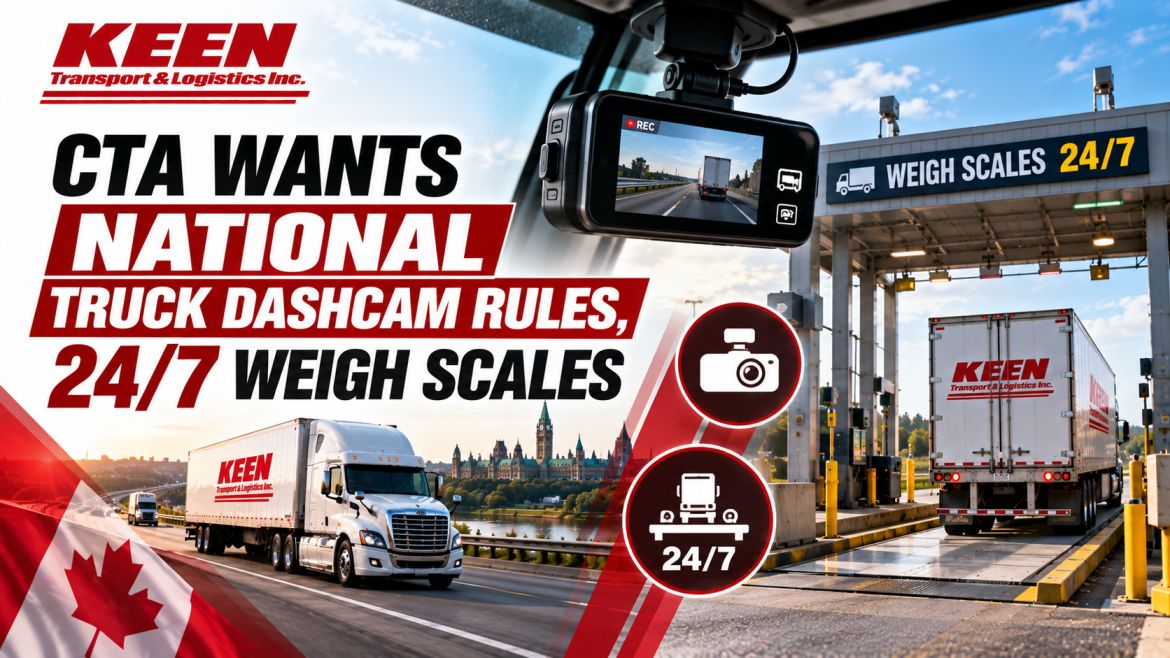
On October 7, 2026, the Canadian Trucking Alliance asked the Council of Ministers Responsible for Transportation and Highway Safety to build national rules for forward-facing truck cameras and to keep truck inspection stations open around the clock. Truck News reported the request, which came from newly appointed CTA chairman Scott Tilley.
It is a proposal, not a regulation. Nothing changes at the scale house tomorrow. But the ask lands while British Columbia is still writing the rules for its own dashcam law, and any Manitoba carrier that hauls west is watching how that plays out.
Here is what is actually on the table, what is still unsettled, and what it means if you ship freight out of Winnipeg.
What This Means for Manitoba Shippers
In the short term, very little changes on your freight. The CTA wants a government-industry process, not an overnight mandate. The association is asking for a 12-month joint working group to develop the national camera framework, so any final rules are well off.
The medium-term picture is different. B.C.’s law covers commercial vehicles travelling its highways, and Manitoba freight does not stop at the Saskatchewan border. If your lanes run through the Rockies to the coast, your carrier will eventually need equipment that meets whatever B.C. finalizes.
Three practical takeaways for shippers and dispatchers:
- Ask your trucking company now whether its trucks already run forward-facing cameras, and what specs those cameras meet.
- Expect some equipment cost to show up in contract rates over time, especially for carriers that need hardware upgrades.
- Keep an eye on enforcement. A carrier that dodges scales today is undercutting honest rates, and the CTA wants that gap closed.
What the CTA Is Asking Governments to Do
According to the Truck News report, the CTA’s request has four parts. They fit together, so it helps to see them side by side.
- National forward-facing camera standards. The CTA wants British Columbia’s work on a regulatory framework for forward-facing cameras in heavy commercial vehicles treated as a pilot for a national standard.
- A 12-month working group. Government and industry would develop the camera framework together and look at gaps in carrier safety oversight.
- 24/7 operation of inspection stations. The CTA says around-the-clock enforcement would stop non-compliant carriers from timing their trips to avoid closed scales.
- Action on the “Satisfactory Unaudited” rating. More on that below, because it matters most to anyone choosing a carrier.
The harmonization argument is the heart of it. The CTA says a single approach would keep differing provincial rules from creating new internal trade barriers. B.C. Trucking Association president and CEO Dave Earle put it this way: “B.C.’s work on forward-facing cameras is an excellent foundation, but safety regulations shouldn’t stop at provincial borders.”
Where B.C.’s Dashcam Law Stands
The B.C. piece is the foundation, so it is worth getting the details straight. Bill M217, the Dashboard Cameras in Commercial Vehicles Act, was introduced by Kamloops-North Thompson MLA Ward Stamer as a private member’s bill. It passed unanimously in May 2026.
As described by Truck News in July, the bill applies to commercial vehicles rated above 11,793 kg GVWR. It calls for forward-facing cameras that record at no less than 1080p, retain at least 72 hours of footage, have night vision, and store footage using the manufacturer’s default settings.
The law is not in effect yet. The B.C. Trucking Association says it will not take effect until supporting regulations are finalized and brought into force. Those regulations are expected to set many of the operational and technical rules.
The open questions
The BCTA formed a Dashcam Task Force of carriers and technology suppliers, and its first meeting in July raised the questions every fleet will eventually face:
- Whether specialized vehicles such as cranes and concrete trucks fall under the rules.
- Whether older cameras can meet both the 1080p and 72-hour requirements, or need replacing.
- Onboard versus cloud storage. Cloud storage can preserve footage if a unit is damaged, while local storage matters where cell coverage is weak.
- Privacy, including a clear line between the mandated forward-facing cameras and inward-facing cameras or audio recording, which are not required.
- Which enforcement agencies can request footage, and how fast carriers must respond.
None of that is settled, which is exactly why the CTA wants a national table before every province writes its own version.
Why Round-the-Clock Inspection Stations Matter
Most dispatchers have heard the story. A scale is closed overnight, so a truck with a questionable load, log or safety record rolls through when nobody is watching. The CTA’s position is that this timing game is deliberate for some carriers.
That matters to you as a shipper even if you never see a roadside inspection. When a non-compliant operator skips enforcement, it carries lower costs, and it can quote lower rates. The trucking company that follows the rules loses the bid, and the shipper ends up carrying risk it cannot see: cargo claims, delays after a roadside shutdown, or a damaged supply chain when a carrier is put out of service.
Any top trucking company has little to fear from longer scale hours. Twenty-four-hour stations would not fix every problem. They would narrow the window in which the worst operators can avoid being checked.
The “Satisfactory Unaudited” Blind Spot
This is the part of the CTA’s request that deserves the most attention from shippers. The CTA says more than 80% of Canadian fleets have never had an on-site safety check. Those carriers carry a “Satisfactory Unaudited” rating, which sounds reassuring and tells you very little.
The CTA calls this a significant blind spot as governments work toward an integrated national truck safety database. Its point is simple: a database is only as good as the data behind it, so the CTA wants a plan to back that information with verified operational data.
Until that happens, vetting falls to the shipper. A good logistics company will answer these questions without hesitating:
- Has your carrier ever had an on-site safety audit, and when?
- Does it own its trucks and employ its drivers, or does it hand your load to someone else?
- Can it show on-time and claims numbers, not just promises?
- Does it hold the certifications your freight needs, such as C-TPAT or dangerous goods handling?
We covered the related push on carrier vetting in our earlier post on the CTA’s call to fast-track carrier vetting rules. This request builds on the same concern.
How Keen Operates
We are an asset-based carrier, a logistics trucking company that runs its own equipment with its own drivers. That is 100+ trucks and 220+ trailers out of Winnipeg, and when your freight is on one of them, you can find out who is driving it and who dispatched it. We are not a broker passing your load down a chain.
For a logistics trucking company that owns its fleet, cameras and inspection hours are a cost of doing business, not someone else’s problem. When the rules change, we adjust our own fleet and our own drivers. We do not have to chase a subcontractor to find out whether they comply.
The shippers we talk to define a top trucking company by its records, not its slogans, so here are ours: 49,450+ loads delivered at a 97.8% on-time rate for 317+ customers. Our dispatch is staffed 24/7 at (204) 943-5336, so a late-night question about a lane gets a person, not a voicemail.
If your freight moves on a dedicated lane, our full truckload service keeps one team on it. For Winnipeg and rural Manitoba runs, our City Division covers daycab and 5-ton work. Shippers who need storage and a single point of coordination can look at our supply chain management options.
We will follow whatever national standard emerges. Until one exists, the best protection for a shipper is a carrier you can check for yourself. Whether you choose us or another logistics company, ask for the proof.
Frequently Asked Questions
Are forward-facing cameras mandatory for Manitoba trucks right now?
The reporting we reviewed describes no Manitoba camera requirement. The only mandate in the sources is B.C.’s Bill M217, and it is not in force until supporting regulations are finalized. The CTA’s October 7 request is for a national framework, which would take at least the 12-month working group process it proposes.
Would a B.C. dashcam law apply to a Manitoba carrier?
Truck News describes the bill as applying to commercial vehicles travelling B.C. highways, so a truck from a Manitoba trucking company running there would be in scope once the rules take effect. The weight threshold in the bill is 11,793 kg GVWR. Check the final regulations for details, since scope questions are still being discussed.
How do I find a reliable trucking company near me in Manitoba?
Start with ownership and audits. A logistics company worth hiring should be able to show you where its trucks and drivers come from. Ask whether the carrier owns its trucks, employs its own drivers, and has ever had an on-site safety audit. Then ask for on-time numbers and the certifications your freight needs. A top trucking company can answer all of it in one call.
What does “Satisfactory Unaudited” actually mean?
It is a safety rating given to carriers that have not had an on-site safety check. The CTA says more than 80% of Canadian fleets are in this category. It is not a failing grade, but it does not prove a carrier has been verified.
Will camera rules raise what a trucking company near me charges?
Possibly, over time. A logistics trucking company with older cameras may need upgrades to meet resolution and retention specs, and those costs tend to work their way into contract pricing. It is too early to put a number on it because B.C.’s regulations are not finalized.
Which trucking company near me can handle Winnipeg and rural Manitoba deliveries?
Keen Transport & Logistics runs a City Division with daycab and 5-ton trucks covering Winnipeg and rural Manitoba. Call dispatch at (204) 943-5336 to talk through your route.
Why does 24/7 inspection coverage matter to a shipper?
Because it limits how long non-compliant carriers can avoid enforcement. When fewer operators dodge the scales, rates become a fairer comparison between carriers, and your freight is less likely to be stranded when a carrier is put out of service.
Ship With a Carrier That Owns Its Fleet
Keen Transport & Logistics runs 100+ trucks and 220+ trailers out of Winnipeg, with a 97.8% on-time record across more than 49,450 loads. No broker markup, no handing your freight to a stranger — our equipment, our drivers, our dispatch.
Call 24/7 dispatch at (204) 943-5336, email info@keentransport.ca, or request a free quote and we’ll price your lane the same day.