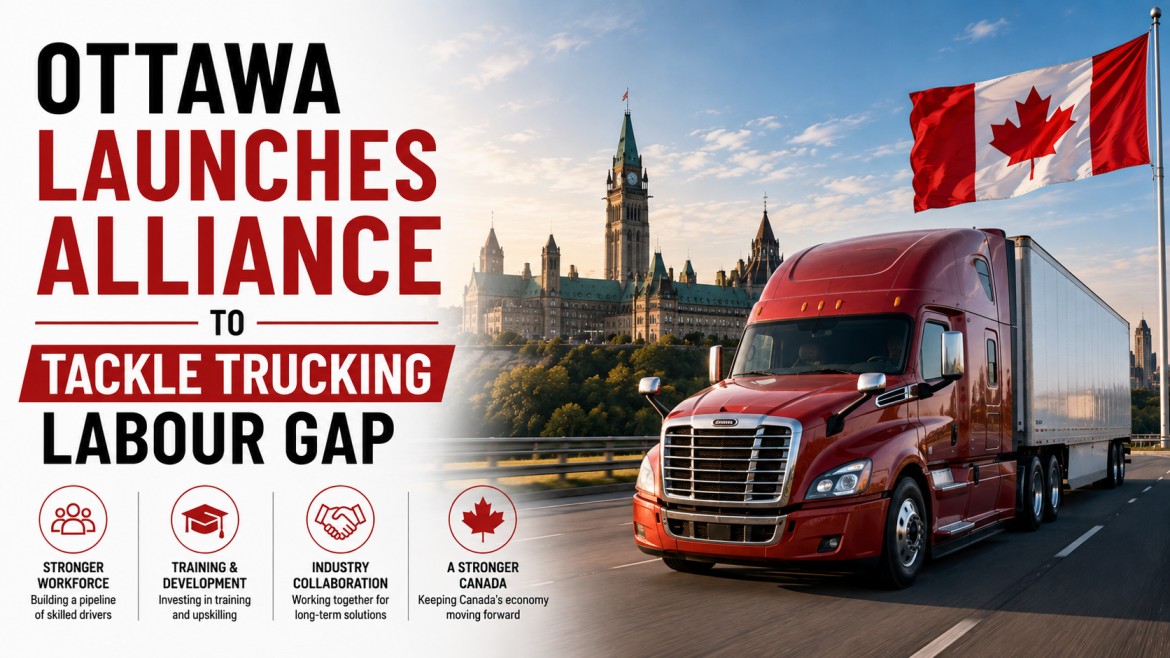
On August 21, 2026, Employment and Social Development Canada issued a media advisory confirming that Minister Patty Hajdu would launch the Transportation and Supply Chain Workforce Alliance on August 24 in Calgary. The event, held at Mount Royal University’s Bissett School of Business, brings together federal officials and industry representatives to address labour shortages and representation gaps across road, rail, air, marine, and warehousing (Canada.ca).
The timing is not accidental. Trucking HR Canada’s most recent labour market update, released May 28, 2026, found that transport truck driver employment fell 7.3 percent year over year, a loss of roughly 23,600 positions, with unemployment in that occupation climbing from 6.4 to 6.7 percent. The broader trucking and logistics sector shed 1,800 jobs over the same period, and 900 fewer drivers were actively looking for work in April 2026 than a year earlier (Trucking HR Canada, via the Canadian Trucking Alliance).
For a Manitoba trucking company watching this from Winnipeg, the federal move is worth paying attention to even though the launch event is in Alberta. Manitoba has been flagged as one of the tightest driver markets in Western Canada for years, and a coordinated national alliance changes how funding, training standards, and recruitment programs might flow to provinces like ours.
What This Means for Manitoba Shippers
For a logistics company juggling multiple Manitoba lanes, a driver shortage does not stay contained to the carriers doing the hauling. When capacity tightens, shippers feel it first as longer lead times, then as higher spot rates when a regular lane needs to be covered on short notice. Manitoba exporters moving pulse crops, soya beans, and manufactured goods to the U.S. border or to port have less room to absorb a missed pickup than they did five years ago.
Shippers who work with an asset-based carrier that owns its trucks and employs its own drivers are somewhat insulated from this, because that carrier is not competing in the spot market for capacity every time volume spikes. What separates a top trucking company from one just filling a truck list usually comes down to driver retention and safety record, not just fleet size, and those numbers are exactly what the labour data above puts pressure on.
Why Ottawa Is Acting Now
The federal government has tried workforce interventions before, but the Transportation and Supply Chain Workforce Alliance is explicitly multimodal. It is not a trucking-only program. Road, rail, air, marine, and warehousing employers are being asked to coordinate rather than compete separately for the same limited federal attention.
That matters for a logistics trucking company that also depends on rail and port partners for intermodal freight. If warehousing and marine labour pools tighten at the same time trucking does, the bottlenecks compound. A single alliance covering all five modes at least puts the problem on one table instead of five separate ones.
Manitoba’s Long-Running Shortfall
This is not a new problem for the province. A Manitoba Trucking Association-commissioned forecast projected the province would face a shortfall of roughly 3,385 drivers by 2026, driven by retirements, the high cost of driver training, and competition from other provinces for the same workers (Manitoba Trucking Association). Former MTA Executive Director Terry Shaw put the arithmetic bluntly at the time: the industry needed more than one new hire a day, every day, for a decade, just to keep pace. For any logistics trucking company operating in Manitoba, that arithmetic hasn’t gone away — it has only tightened.
Manitoba’s newly seated MTA leadership, which took over following the association’s April 2026 annual general meeting, has already named “labour market integrity” and workforce development among its priorities for the coming term. A federal alliance with dedicated attention to representation gaps lines up with what the provincial association has been asking for.
What the Alliance Aims to Do
Details beyond the August 24 launch were still limited as of this writing, since the advisory covered the announcement itself rather than a finished program. Based on what ESDC has published, the alliance is meant to function as a standing coordination body rather than a one-time grant. Expect it to focus on recruitment into underrepresented groups, retention data-sharing across modes, and pressure-testing training pipelines that currently vary a great deal by province.
For carriers, the practical question is whether funding or standards eventually flow down to the provincial training bodies Manitoba already relies on. Until that detail is public, treating this as a reason to change which trucking company you contract with today would be premature — the more useful move is watching how the alliance’s first programs get funded.
How Keen Approaches Recruitment in a Tight Market
Keen Transport & Logistics, a logistics trucking company based in Winnipeg, has built its own answer to this labour market rather than waiting for policy to catch up. The company runs more than 180 employees and over 100 trucks out of its Winnipeg base, delivering on a 97.8 percent on-time record across more than 49,450 loads for over 317 customers. That kind of scale only holds together for a trucking company willing to invest steadily in recruitment instead of leaning on the spot market when volume spikes.
As an asset-based carrier, Keen owns its equipment and employs its drivers directly rather than brokering loads out to third parties, which gives dispatch and safety staff more control over how new hires are trained and mentored. The company is also a diverse-owned and visible-minority-owned business that partners with women-owned and Indigenous-led enterprises, which broadens the pool it recruits from at a time when the THRC data shows that pool shrinking nationally. It’s part of why long-term customers still describe Keen as a top trucking company even as capacity has tightened elsewhere. Open driving positions and the rest of Keen’s current openings are posted directly rather than routed through a staffing agency.
Freight customers benefit from this indirectly. A logistics company that is not scrambling to cover lanes with borrowed capacity delivers a more predictable transit time, which is part of why Keen’s full truckload service and City Division daycab and 5-ton fleet have held onto long-term Manitoba customers through tighter labour years like this one.
Frequently Asked Questions
How do I find a reliable trucking company near me in Manitoba?
Start with carrier safety ratings, ask how much of the fleet is company-owned versus brokered, and check certifications like C-TPAT, SmartWay, and Hazmat if your freight needs them. References from existing customers on the same lanes usually tell you more than a search results page.
Is it better to call a trucking company near me directly, or request a quote online?
Either works, but a phone call to 24/7 dispatch gets you a real conversation about your lane, timing, and equipment needs faster than a generic web form in most cases. Keen’s dispatch line is answered around the clock for exactly this reason.
Does the driver shortage actually affect my freight rates?
Yes, though the effect shows up unevenly. Spot-market rates react fastest when capacity tightens, while contracted rates with a logistics company that books its own capacity in advance tend to move more slowly since it is not rebidding your freight to outside trucks every week.
What does the Transportation and Supply Chain Workforce Alliance actually change for shippers right away?
Nothing immediately. The August 24 launch establishes the alliance; specific programs, funding, or training standards were not detailed in the initial advisory, so any near-term effect on capacity or rates is still speculative.
What should I look for in a top trucking company besides on-time percentage?
Look at how long drivers stay, whether the fleet is owned or leased from outside carriers, and what certifications back up cross-border or hazmat claims. On-time percentage matters, but it is easier to sustain when the underlying driver and equipment base is stable.
Why does Keen use its own drivers instead of brokering loads?
Keeping drivers on staff lets Keen control training, safety standards, and scheduling directly, which is part of how it maintains a 97.8 percent on-time delivery record. It also means customer freight is not handed off to an unknown subcontractor mid-route.
Should I choose the trucking company near me with the lowest quote, or the one with the best on-time record?
The lowest quote is not always the cheapest option once you account for missed pickups, claims, or a broker substituting an unfamiliar subcontractor. Weigh the quote against on-time history and whether the carrier owns the equipment that will actually move your freight.
Ship With a Carrier That Owns Its Fleet
Keen Transport & Logistics runs 100+ trucks and 220+ trailers out of Winnipeg, with a 97.8% on-time record across more than 49,450 loads. No broker markup, no handing your freight to a stranger — our equipment, our drivers, our dispatch.
Call 24/7 dispatch at (204) 943-5336, email info@keentransport.ca, or request a free quote and we’ll price your lane the same day.