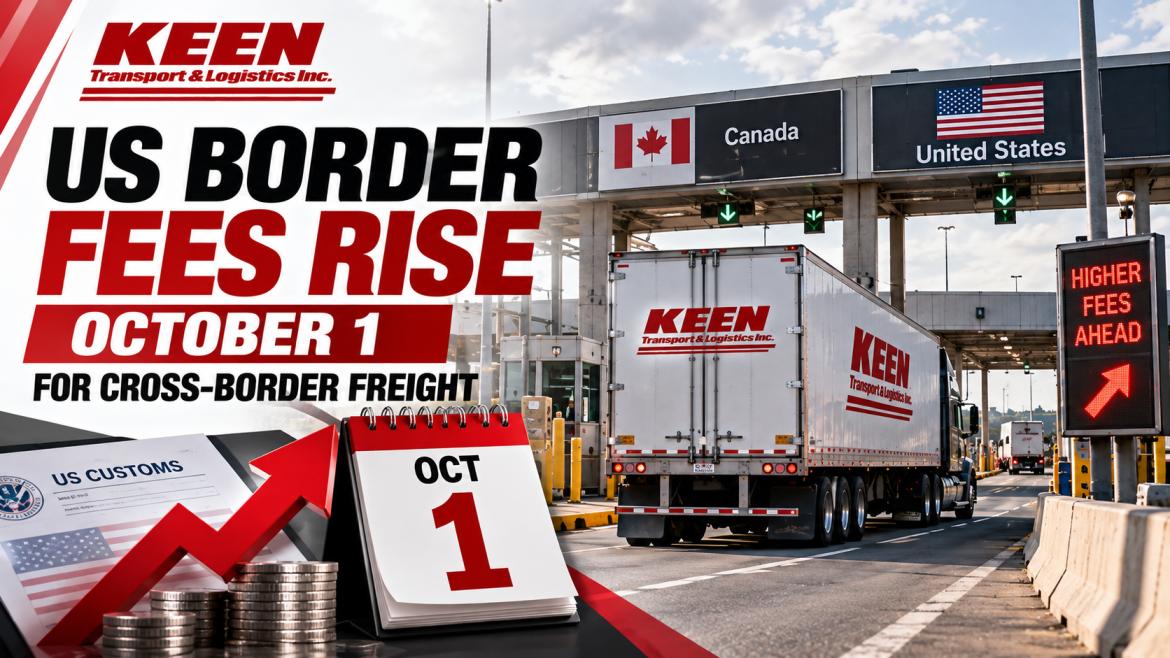
Starting October 1, 2026, it will cost more to send a truck across the Canada-US border. U.S. Customs and Border Protection published its fiscal year 2027 fee adjustment in the Federal Register on July 31, 2026, and the combined single-crossing charge for commercial trucks rises to $22.10 U.S. per crossing.
The increase is driven almost entirely by the U.S. Department of Agriculture’s Animal and Plant Health Inspection Service (APHIS) Agricultural Quarantine and Inspection (AQI) fee, which climbs from $13.45 to $14.50 per crossing. The Canadian Trucking Alliance flagged the change to members on September 18. The CBP portion of the fee, by contrast, barely moves, ticking down a cent to $7.60 under the standard rounding rule CBP applies each year.
For any logistics trucking company that runs regular US lanes out of Manitoba, this is the kind of change that’s easy to miss in a July government notice and expensive to discover in October. Here’s what’s actually changing, why it happens every year, and what it means for shippers who move freight across the border.
What This Means for Manitoba Shippers
On paper, a dollar increase per crossing sounds minor. In practice, a carrier running daily US lanes multiplies that dollar by hundreds of crossings a year, and it shows up somewhere — either absorbed into overhead or passed through on the fuel and border surcharge line of a freight invoice.
For shippers who prepay the annual transponder fee instead of paying per crossing, the change is more noticeable. The combined annual fee rises from roughly $939 to $1,008.92 U.S., an increase of about 7.4%. That is real money for a fleet running dozens of trucks across the Emerson or Pembina crossings on a regular basis.
For a logistics company juggling multiple US lanes, a few dollars per crossing adds up fast across a full fleet. The takeaway for shippers moving goods into the US market: ask your freight provider now how they plan to handle the increase, rather than finding out when a January invoice looks different than expected.
What’s Changing at the Border on October 1
The fee update comes from two agencies at once, which is part of why it gets confusing. CBP adjusts its own portion of several border fees every fall based on a cumulative inflation factor measured against a 2014 baseline; this year that factor works out to a 2.841% increase in the underlying index. USDA APHIS separately adjusts the AQI fee, which pays for agricultural inspection at the border, and that fee moves on its own schedule through fiscal year 2028.
Here’s the breakdown for a single truck crossing effective October 1, 2026:
- CBP Commercial Truck Arrival Fee: $7.60 (down from $7.61)
- USDA APHIS AQI Fee: $14.50 (up from $13.45)
- Combined Single Crossing Fee: $22.10 (up from roughly $21.06)
For carriers that prepay annually rather than per crossing, the CBP portion moves to $138.32 and the APHIS AQI transponder portion moves to $870.60, for a combined annual total of $1,008.92.
Why This Fee Keeps Climbing Every Year
Neither of these fees is new, and neither increase is a one-off. CBP has adjusted its user fees for inflation on a near-annual basis for over a decade, and the AQI fee has followed a similar pattern since APHIS restructured the program in 2023. The Federal Register notice is explicit that further AQI adjustments are scheduled through fiscal year 2028, so this is not the last increase a cross-border trucking company should expect.
What makes this year’s notice worth reading closely is the split between the two fees. The CBP side essentially held flat, which tells you the increase is not about general inflation catching up to trucking specifically — it’s the agricultural inspection side of the border that’s getting more expensive to run, likely reflecting staffing and inspection capacity at land ports along the Canada-US line. Every logistics company running cross-border freight should expect a similar notice again next July, since APHIS adjustments are scheduled annually through fiscal year 2028.
What separates a top trucking company from the rest isn’t dodging fee increases like this one — it’s building them into rate planning long before October arrives.
The Bigger Picture for Manitoba’s Cross-Border Freight
Manitoba’s economy leans heavily on freight that crosses this exact border. Grain, pulse crops, and processed agricultural products move south daily, and finished goods, parts, and retail freight move north. A fee increase tied to agricultural inspection lands directly on the lanes Manitoba exporters use most.
This isn’t happening in isolation. The CBSA published an updated guide to importing commercial goods into Canada on September 18, and Ottawa has spent much of 2026 adjusting tariff relief programs and carrier vetting rules on the Canadian side of the ledger. Add a US-side fee increase to that list, and the compliance picture for a cross-border trucking company gets a bit more complicated every few months, even without any single change being dramatic on its own.
None of this changes the fundamentals of what makes a shipment reliable. It just means paperwork, prepayment schedules, and fee budgets need a fresh look more often than they used to.
What Carriers and Shippers Should Do Now
A few practical steps before October 1 arrives:
- Confirm whether your logistics trucking company pays AQI fees per crossing or through an annual transponder, and ask which option makes more sense for your shipment volume.
- If you prepay annually, budget for the $1,008.92 combined total rather than last year’s number.
- Ask your full truckload provider whether the increase is being absorbed, itemized, or built into the rate — get it in writing either way.
- If your freight moves through multiple modes, check whether shifting some volume to rail-and-truck intermodal service changes your border-fee exposure at all, since crossing frequency is what drives the cost.
How Keen Handles Cross-Border Freight
Keen Transport & Logistics is a US and Canada bonded, C-TPAT certified asset-based carrier — the kind of credential list that separates a top trucking company from one scrambling every fall — and we budget for AQI and CBP fee adjustments as a normal part of running cross-border lanes, not a surprise every October.
We run over 100 trucks and 220+ trailers out of our Winnipeg terminal, with 24/7 dispatch coordinating cross-border pickups and deliveries. Because we’re an asset-based carrier and not a broker, there’s no middleman adding a markup on top of border fees — our drivers, our equipment, our paperwork, from pickup to delivery.
That matters most for the markets we serve heavily on the export side: pulse crops, soya bean, and other special crops moving from Manitoba into the US, alongside manufacturing and retail freight moving both directions. As a logistics trucking company built around owned equipment rather than brokered capacity, our supply chain management services build fee changes like this one into routing and rate planning rather than leaving shippers to absorb them after the fact.
Frequently Asked Questions
Does this fee increase apply to every truck crossing the border, or only certain shipments?
It applies to commercial trucks carrying goods subject to APHIS agricultural inspection, which covers most freight moving into the US, not just agricultural cargo. Empty trucks and certain exempt categories may be treated differently, so ask your trucking company directly if you’re unsure how it applies to your freight.
Will Keen or other carriers pass this fee increase on to shippers?
That depends on the carrier and how the fee is structured into their rates. The way a top trucking company handles this kind of change is by disclosing it upfront, not waiting for a shipper to notice a different number on an invoice.
How do I find a reliable trucking company near me in Manitoba that already handles cross-border compliance?
Look for a carrier that’s US and Canada bonded with current C-TPAT certification, since both are signs the company already manages border paperwork and fee changes as routine business rather than reacting to them after the fact.
Is a local trucking company near me a better fit for US-Canada freight than a national broker?
An asset-based local carrier often gives more direct control over cross-border timing and paperwork than a broker reselling capacity, since you’re dealing with the company that owns the truck and holds the bonding, not a middle layer.
What should I ask a trucking company near me about how they handle AQI and CBP fees?
Ask whether they prepay the annual transponder or pay per crossing, how they plan to handle the October 1 increase, and whether that cost appears as a separate line item on your invoice or gets folded into the rate.
Does the annual transponder prepayment make sense for occasional cross-border shippers?
Usually not. The prepayment favours carriers running frequent, high-volume crossings. A shipper with only occasional US freight is typically better served by a carrier that pays per crossing and passes through the actual cost.
Where can shippers verify these fee numbers directly?
The Federal Register notice published July 31, 2026 and USDA APHIS’s commercial truck fee page both list the official FY2027 rates. Any established logistics company should be able to point you to the same figures without hesitation, since the numbers are public and worth checking directly rather than relying on secondhand summaries.
Ship With a Carrier That Owns Its Fleet
Keen Transport & Logistics runs 100+ trucks and 220+ trailers out of Winnipeg, with a 97.8% on-time record across more than 49,450 loads. No broker markup, no handing your freight to a stranger — our equipment, our drivers, our dispatch.
Call 24/7 dispatch at (204) 943-5336, email info@keentransport.ca, or request a free quote and we’ll price your lane the same day. Questions about how border fee changes affect your specific shipments? Contact our team directly.